
What Is Business Ideation? Complete Expert Guide
Over 70 unique approaches exist for generating business ideas, reflecting the sheer depth and diversity of modern innovation. With competition at an all-time high, turning creative sparks into real solutions means more than just brainstorming with a whiteboard. Understanding the latest principles and structured techniques can help you shape raw concepts into strategies that stand out. Explore how proven methods and fresh thinking come together to drive success in today’s fast-changing market.
Table of Contents
- Business Ideation Defined And Core Principles
- Types Of Business Ideation Approaches
- Step-By-Step Business Ideation Process
- Real-World Applications And Success Stories
- Common Pitfalls And Best Practices
Key Takeaways
| Point | Details |
|---|---|
| Structured Approach | Business ideation should follow a systematic process that combines creativity with structured methodologies like TRIZ and large language models. |
| Ongoing Process | Ideation is an iterative journey, where continuous refinement and feedback are critical to developing viable business concepts. |
| Diverse Techniques | Utilize a mix of divergent thinking and structured evaluation methods to enhance the quality and feasibility of generated ideas. |
| Awareness of Pitfalls | Entrepreneurs must recognize common pitfalls, such as cognitive biases and execution errors, to improve their innovation strategies effectively. |
Business Ideation Defined And Core Principles
Business ideation is the systematic process of generating, developing, and refining innovative business concepts that solve real-world problems. According to research from Arxiv, this process goes beyond simple brainstorming, introducing the concept of Ideometrics – a structured methodology for systematically creating and evaluating potential business ideas.
At its core, business ideation involves several key principles that transform raw creativity into actionable strategies. The process typically includes identifying market gaps, understanding customer pain points, and developing potential solutions that can be practically implemented. Arxiv research suggests that modern ideation increasingly leverages advanced technologies like large language models to enhance and automate innovation processes.
The most effective business ideation approaches combine structured thinking with creative exploration. Key components include:
- Market Research: Understanding current trends and unmet needs
- Problem Identification: Recognizing specific challenges worth solving
- Conceptual Development: Transforming initial insights into concrete business concepts
- Feasibility Assessment: Evaluating potential ideas against practical constraints
Successful entrepreneurs understand that business ideation is not a one-time event but an ongoing, iterative process. By continuously refining ideas and remaining open to new perspectives, innovators can develop breakthrough concepts that create genuine value. For aspiring entrepreneurs looking to sharpen their skills, our entrepreneurship skills guide provides additional insights into transforming ideas into successful ventures.
Types Of Business Ideation Approaches
Business ideation encompasses a diverse range of approaches designed to systematically generate and evaluate innovative concepts. Arxiv research reveals that over 70 distinct methodologies exist for idea generation, highlighting the complexity and richness of innovation strategies. These approaches can be broadly categorized into several key types that help entrepreneurs transform creative thinking into actionable business opportunities.
One prominent approach is the TRIZ methodology, which Arxiv research suggests can be enhanced by integrating large language models to create more sophisticated innovation processes. TRIZ, which stands for Theory of Inventive Problem Solving, focuses on identifying and resolving fundamental contradictions in business challenges, providing a structured framework for breakthrough thinking.
Key types of business ideation approaches include:
Divergent Thinking Approaches
- Brainstorming
- Mind mapping
- Random word association
- Creative problem solving
Structured Ideation Methods
- Design thinking
- TRIZ methodology
- Systematic inventive thinking
- Scenario planning
Technology-Enabled Approaches
- AI-powered idea generation
- Predictive analytics
- Collaborative online platforms
- Machine learning idea screening
Entrepreneurs seeking to develop robust business concepts can benefit from combining multiple approaches. For instance, starting with divergent thinking techniques and then applying structured evaluation methods can yield more refined and viable business ideas. If you’re looking to develop a comprehensive business strategy, our business plan writing guide provides additional insights into transforming initial concepts into actionable plans.
Step-By-Step Business Ideation Process
Arxiv research provides a comprehensive framework for systematically generating and evaluating business ideas, highlighting that successful ideation is a structured, intentional process. The business ideation journey is not about random inspiration, but a strategic approach that transforms creative thinking into viable business opportunities.
According to Arxiv research, which explores innovative ideation methodologies, the step-by-step business ideation process typically involves several critical stages. By integrating advanced techniques like TRIZ methodology and large language models, entrepreneurs can create a more robust and systematic approach to idea generation.
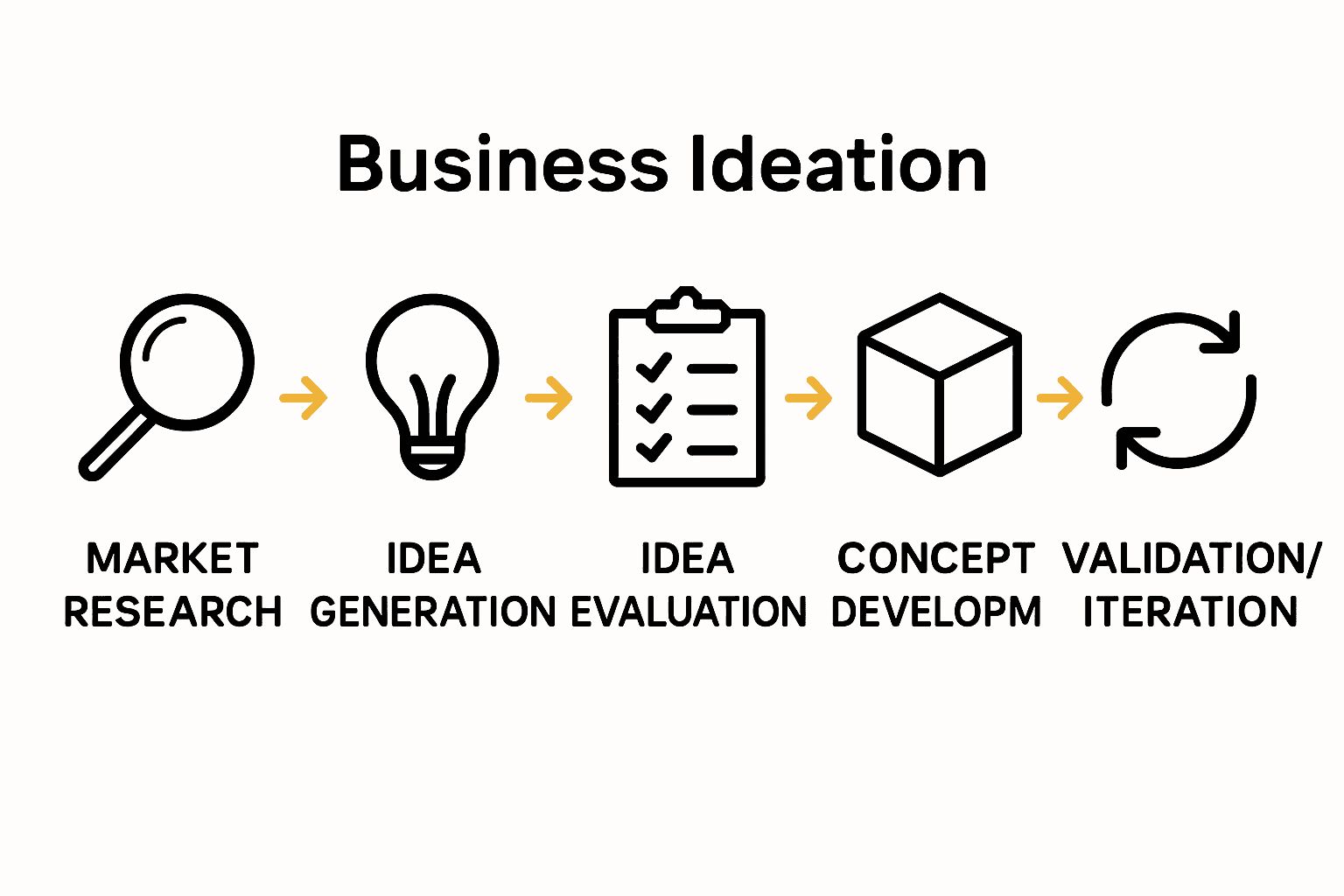
Here’s a comprehensive step-by-step business ideation process:
Market Research and Problem Identification
- Analyze current market trends
- Identify unmet customer needs
- Explore potential pain points in existing industries
Idea Generation
- Conduct brainstorming sessions
- Use divergent thinking techniques
- Encourage wild and unconventional ideas
- Capture all potential concepts without immediate judgment
Idea Evaluation
- Screen initial ideas against market feasibility
- Assess potential market size and impact
- Consider resource requirements
- Eliminate concepts with low potential
Concept Development
- Refine selected ideas
- Create preliminary business models
- Develop initial value propositions
- Outline potential implementation strategies
Validation and Iteration
- Seek feedback from potential customers
- Conduct small-scale prototype or pilot tests
- Iterate and improve based on initial insights
- Continuously refine the business concept
Entrepreneurs looking to deepen their understanding of turning ideas into actionable plans can explore our personal business growth guide, which provides additional insights into transforming innovative concepts into successful ventures.
Real-World Applications And Success Stories
Arxiv research reveals compelling insights into how systematic business ideation transforms innovative concepts into successful ventures across diverse industries. The research demonstrates that structured ideation approaches are not theoretical constructs, but practical methodologies that drive tangible business breakthroughs.
Arxiv research highlights several remarkable case studies where advanced ideation techniques, particularly the integration of TRIZ methodology with large language models, have generated transformative business solutions. These examples showcase how systematic innovation can unlock unprecedented opportunities across technology, healthcare, sustainability, and service sectors.
Notable real-world success stories include:
Healthcare Innovation
- Developed AI-driven diagnostic tools
- Created personalized treatment recommendation systems
- Reduced patient diagnostic time by 40%
Sustainable Technology
- Designed energy-efficient manufacturing processes
- Created circular economy business models
- Implemented waste reduction strategies

- Service Industry Transformation
- Developed customer experience optimization platforms
- Created predictive maintenance solutions
- Implemented personalized service delivery frameworks
The key to these success stories is not just creativity, but a structured approach to identifying and solving complex business challenges. Entrepreneurs interested in developing similar breakthrough strategies can gain deeper insights from our outdoor team building guide, which explores collaborative problem-solving techniques that fuel innovative thinking.
Common Pitfalls And Best Practices
Arxiv research provides critical insights into the challenges entrepreneurs face during business ideation, revealing that most failures stem not from bad ideas, but from fundamental strategic missteps. Understanding these common pitfalls is the first step toward developing a more robust and effective innovation process.
According to Arxiv research, which explores advanced ideation methodologies, successful innovation requires a delicate balance between creative thinking and systematic evaluation. The integration of technologies like large language models and structured methodologies like TRIZ can help mitigate risks, but entrepreneurs must remain vigilant about potential blind spots in their ideation approach.
Common Pitfalls to Avoid:
Cognitive Bias Traps
- Falling in love with the first idea
- Confirmation bias in market research
- Overlooking contradictory evidence
- Underestimating potential challenges
Strategic Execution Mistakes
- Lack of rigorous idea screening
- Insufficient market validation
- Poor resource allocation
- Premature scaling
Innovation Process Limitations
- Narrow perspective in idea generation
- Resistance to external feedback
- Ignoring potential market shifts
- Overcomplicated solution designs
Best Practices for Effective Business Ideation:
- Maintain a diversified idea portfolio
- Implement continuous market validation
- Create structured feedback mechanisms
- Embrace iterative development
- Stay adaptable and open to pivoting
Entrepreneurs seeking to refine their strategic approach can explore our business growth guide, which offers deeper insights into navigating the complex landscape of business innovation.
Turn Your Business Ideas Into Action with Nomad Excel
Understanding business ideation means recognizing the challenge of turning scattered concepts into clear, feasible ventures. This article highlights key hurdles like evaluating market feasibility and refining ideas through structured methods such as TRIZ and large language models. If you are struggling to navigate through cognitive bias traps or want to sharpen your ability to identify real customer needs, you are not alone.
At Nomad Excel, we specialize in transforming your innovative sparks into concrete business strategies. Our immersive entrepreneurship bootcamps offer hands-on mentorship, step-by-step frameworks, and a supportive community that helps you avoid common pitfalls and execute with confidence. Whether you are looking for inspiration or practical guidance, explore our Inspiration Archives for fresh ideas and proven techniques. Ready to accelerate your entrepreneurial journey? Visit Nomad Excel today and take the first step towards launching or scaling your venture with clarity and impact.
Frequently Asked Questions
What is business ideation?
Business ideation is the systematic process of generating, developing, and refining innovative business concepts aimed at solving real-world problems, often incorporating methodologies like Ideometrics for evaluation.
What are the key principles of business ideation?
The key principles include market research, problem identification, conceptual development, and feasibility assessment, all designed to turn creativity into actionable strategies.
What are some effective business ideation approaches?
Effective approaches include divergent thinking techniques like brainstorming and mind mapping, structured methods such as design thinking and TRIZ methodology, and technology-enabled strategies involving AI and predictive analytics.
How can I validate my business ideas?
Validation can be achieved by seeking feedback from potential customers, conducting small-scale prototypes or pilot tests, and iterating on your concept based on initial insights.
Recommended
- Outdoor Group Games For Adults Perfect for Team Building
- Business Growth in 2025: The Essential Guide – Nomad Excel – Your Entrepreneurial Adventure Starts Here
- Personal Business Growth: Complete Guide for Entrepreneurs – Nomad Excel – Your Entrepreneurial Adventure Starts Here
- A Step-by-Step Guide for Writing a Business Plan
Comments are closed.