
Complete Guide to Entrepreneurial Thinking
Most people associate entrepreneurship with launching a startup, yet the real game-changer is adopting an entrepreneurial mindset in everyday life. Research shows that those with an entrepreneurial mindset are significantly more likely to spot and seize opportunities—even with incomplete information. This mental approach leads to creative problem-solving, resilience, and smarter decision-making across any career or industry. Discover how developing entrepreneurial thinking can unlock new ways to respond to challenges and fuel ongoing personal and professional growth.
Table of Contents
- Defining Entrepreneurial Thinking and Mindset
- Core Traits and Skills of Entrepreneurial Thinkers
- How Entrepreneurial Thinking Drives Innovation
- Real-World Applications for Individuals and Teams
- Common Misconceptions and Mistakes to Avoid
Key Takeaways
| Key Point | Details |
|---|---|
| Entrepreneurial Mindset | It involves a flexible mental framework focused on recognizing opportunities, resilience, and strategic decision-making. |
| Core Traits and Skills | Key traits include creativity, adaptability, a high tolerance for risk, and a commitment to lifelong learning. |
| Driving Innovation | Entrepreneurial thinking catalyzes innovation by reframing problems and enhancing resource optimization and adaptive thinking. |
| Misconceptions | Common myths about entrepreneurship can hinder development; successful entrepreneurs view it as a skill that can be cultivated through learning. |
Defining Entrepreneurial Thinking and Mindset
Entrepreneurial thinking is more than just starting a business—it’s a powerful mental framework that transforms how individuals approach challenges, opportunities, and uncertainty. According to sagepub.org, entrepreneurial mindset represents a mental process that empowers individuals to recognize and act on valuable opportunities, even when information is incomplete.
At its core, an entrepreneurial mindset is characterized by five fundamental themes:
- Mental Agility: The ability to think flexibly and adaptively
- Value Creation: Constantly seeking ways to generate meaningful solutions
- Opportunity Recognition: Identifying potential where others see obstacles
- Resilience: Maintaining momentum despite complex and uncertain conditions
- Strategic Decision Making: Taking calculated risks with limited information
Entrepreneurial thinking goes beyond traditional business approaches. As ntnuopen.ntnu.no highlights, this mindset involves a cognitive process that promotes creativity, problem-solving, and an openness to explore uncharted territories. It’s about cultivating a perspective that views challenges as opportunities for growth and innovation.
This mindset isn’t reserved for founders or startup leaders. Anyone can develop entrepreneurial thinking by practicing curiosity, embracing uncertainty, and maintaining a proactive approach to personal and professional development. The key is shifting from a reactive stance to a strategic, opportunity-seeking perspective that sees potential where others see limitations.
For those eager to dive deeper into developing an entrepreneurial mindset, our guide to the benefits of an entrepreneurial mindset offers practical insights and strategies to kickstart your entrepreneurial journey.
Core Traits and Skills of Entrepreneurial Thinkers
Entrepreneurial thinking is distinguished by a unique set of core traits and skills that set successful innovators apart from the crowd. According to par.nsf.gov, key characteristics of an entrepreneurial mindset include opportunity seeking, adaptability, and a need for achievement that drives continuous personal and professional growth.
The essential traits of entrepreneurial thinkers can be categorized into several critical domains:
Cognitive Skills
- High creativity and innovative problem-solving
- Adaptability in complex environments
- Strategic thinking and opportunity recognition
Psychological Attributes
- High tolerance for risk and uncertainty
- Perseverance through setbacks
- Strong internal motivation
Learning Orientation
- Commitment to lifelong learning
- Openness to new experiences
- Continuous skill development
Research from academic.oup.com further reveals that entrepreneurs typically demonstrate a unique personality profile. This includes high internal locus of control, meaning they believe they can influence outcomes through their actions, and emotional stability that allows them to navigate challenging business landscapes with composure.
To truly develop an entrepreneurial mindset, individuals must intentionally cultivate these traits through consistent practice and self-reflection. Embracing challenges, seeking feedback, and maintaining a growth-oriented perspective are crucial steps. While some traits might come more naturally to certain individuals, entrepreneurial thinking is a skill that can be learned and refined over time.

If you’re looking to systematically enhance your entrepreneurial skills, our entrepreneurship skills checklist provides a comprehensive framework for identifying and developing key competencies that drive entrepreneurial success.
How Entrepreneurial Thinking Drives Innovation
Entrepreneurial thinking serves as a powerful catalyst for innovation, transforming complex challenges into breakthrough opportunities. According to igbr.org, cultivating an entrepreneurial mindset infuses innovative thinking specifically targeted at addressing difficult problems and exploring new revenue streams.
The innovation process driven by entrepreneurial thinking involves several critical mechanisms:
Problem Reframing
- Viewing challenges as opportunities
- Challenging existing assumptions
- Developing creative solution approaches
Adaptive Thinking
- Rapid prototype development
- Iterative problem-solving
- Continuous learning and adjustment
Resource Optimization
- Maximizing limited resources
- Finding unexpected connections
- Creating value through unconventional strategies
Interestingly, emerging research from arxiv.org highlights how technological advancements are expanding entrepreneurial innovation capabilities. The AI Enabled Individual Entrepreneurship Theory (AIET) demonstrates how artificial intelligence can transform individual entrepreneurial potential by augmenting skills, modifying risk profiles, and enabling unprecedented scales of innovation.
Successful innovation requires more than just generating ideas—it demands a systematic approach to transforming creative insights into tangible value. Entrepreneurs who master this process understand that innovation is both an art and a science, requiring disciplined thinking, continuous experimentation, and the courage to challenge conventional wisdom.
For entrepreneurs seeking to develop a structured approach to innovation, our guide on business ideation provides actionable strategies to systematically generate and validate groundbreaking business concepts.
Real-World Applications for Individuals and Teams
Entrepreneurial thinking transforms how individuals and teams approach challenges, creating powerful strategies for success across various professional contexts. According to arxiv.org, the success of entrepreneurial ventures heavily depends on founder personality traits and team composition, with research highlighting the critical importance of diverse skill sets and complementary personality types.
Real-world applications of entrepreneurial thinking manifest in several key areas:
Individual Performance
- Personal problem-solving approaches
- Career development strategies
- Self-directed learning and skill acquisition
Team Dynamics
- Collaborative innovation processes
- Cross-functional communication
- Adaptive project management
Organizational Innovation
- Identifying emerging market opportunities
- Creating flexible business models
- Implementing agile decision-making frameworks
Research from arxiv.org reveals a groundbreaking approach to understanding entrepreneurial potential through a validated scale that assesses how individuals and teams can apply entrepreneurial thinking in practical scenarios. This research demonstrates that successful entrepreneurial application isn’t just about individual brilliance, but about creating synergistic team environments that leverage diverse strengths.
The most effective entrepreneurial teams often embrace a “Hipster, Hacker, and Hustler†model, where creative thinkers, technical experts, and business strategists collaborate to drive innovation. This approach allows teams to combine diverse perspectives, mitigate individual limitations, and create more robust solutions to complex challenges.
For teams looking to enhance their collaborative potential, our outdoor group games for team building offer innovative ways to develop entrepreneurial thinking and strengthen team dynamics through engaging, practical experiences.
Common Misconceptions and Mistakes to Avoid
Entrepreneurial thinking is often misunderstood, with numerous myths preventing aspiring entrepreneurs from developing their true potential. According to e-elgar.com, cutting-edge research emphasizes the importance of dispelling common entrepreneurship myths and helping individuals think from different perspectives to avoid preventable mistakes.
Common misconceptions about entrepreneurial thinking include:
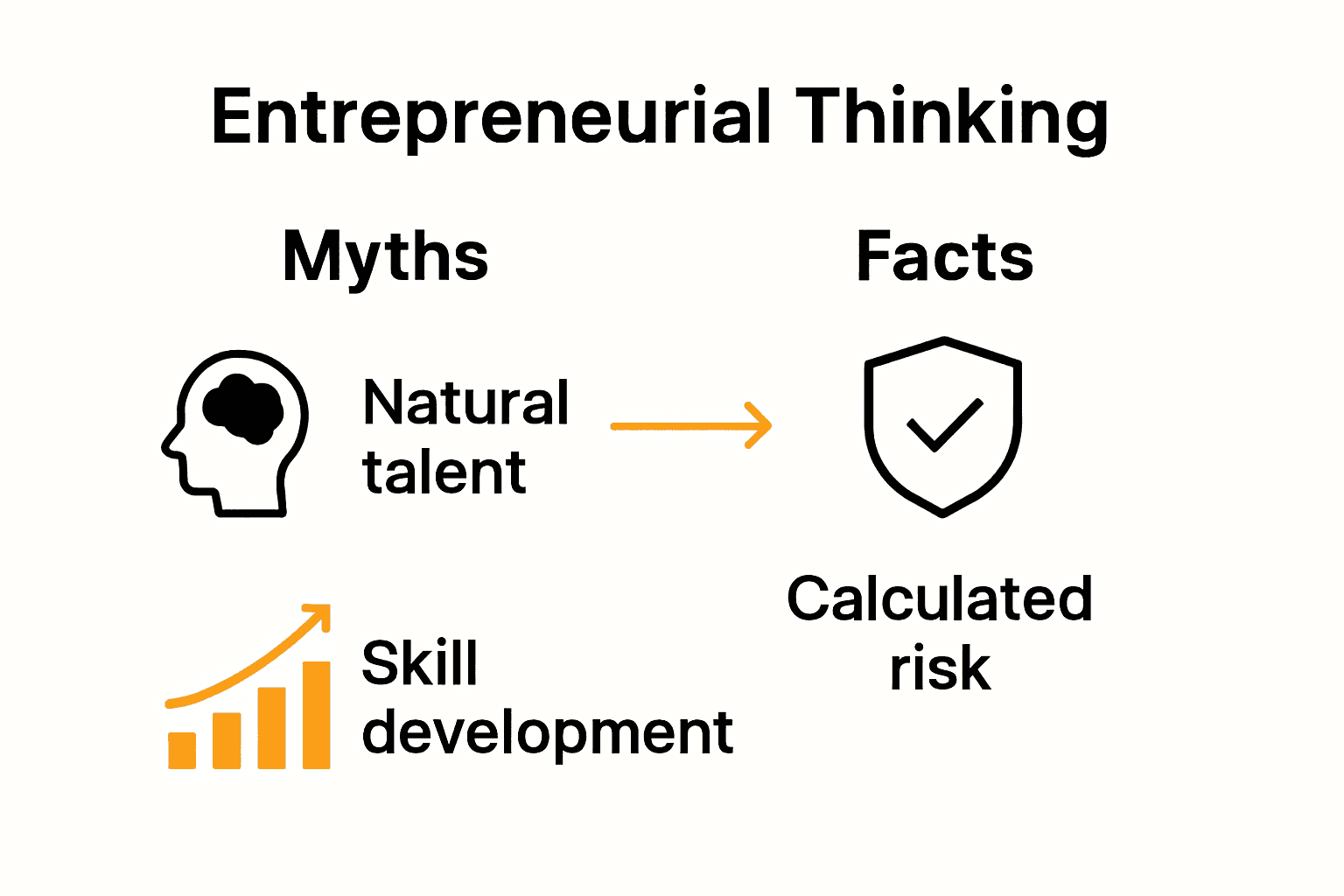
Myth of Natural Talent
- Believing entrepreneurship is only for ‘born’ entrepreneurs
- Overlooking the importance of learned skills
- Dismissing the role of continuous learning
Risk Perception Errors
- Assuming all entrepreneurs are extreme risk-takers
- Misunderstanding calculated versus reckless risk
- Failing to differentiate between strategic and impulsive decisions
Success Narrative Fallacies
- Romanticizing overnight success stories
- Ignoring the hard work behind seemingly sudden breakthroughs
- Underestimating the importance of persistent effort
Research from innovation-entrepreneurship.springeropen.com highlights a critical insight: entrepreneurial success is not solely based on innate traits. Many entrepreneurs mistakenly believe their natural leadership qualities guarantee success, overlooking the crucial importance of developing specific thinking dimensions such as risk assessment, innovation, and opportunity recognition.
The most dangerous mistake is treating entrepreneurial thinking as a fixed trait rather than a skill that can be systematically developed. Successful entrepreneurs continuously learn, adapt, and challenge their own assumptions. They understand that entrepreneurial thinking is a dynamic process of growth, requiring consistent self-reflection, learning, and intentional skill development.
To help aspiring entrepreneurs navigate these challenges, our essential leadership skills guide for digital nomads provides practical strategies for developing the mindset and skills needed to overcome common entrepreneurial thinking obstacles.
Unlock Your Entrepreneurial Mindset with Nomad Excel
The Complete Guide to Entrepreneurial Thinking reveals how vital mental agility, resilience, and strategic decision making are for turning challenges into opportunities. If you have struggled to apply these concepts or feel stuck overcoming uncertainty and recognizing real value in your ideas, you are not alone. Many driven individuals face roadblocks in transforming entrepreneurial thinking into practical action.
At Nomad Excel we specialize in bridging that gap through immersive entrepreneurship bootcamps and custom team retreats. Our programs focus on step-by-step frameworks for idea validation, skill mastery, and building a community that holds you accountable. With experienced mentors and like-minded peers by your side, you accelerate your growth with real-world execution rather than empty theory.
Ready to put entrepreneurial thinking into practice? Explore our Entrepreneurship Archives to learn more about our proven approaches. Take the first step today by visiting Nomad Excel and discover how joining a focused bootcamp or retreat can fast track your transformation. Don’t let hesitation hold back your potential to innovate and lead. Your entrepreneurial adventure starts now.
Frequently Asked Questions
What is entrepreneurial thinking?
Entrepreneurial thinking is a mental framework that empowers individuals to recognize and act on valuable opportunities, characterized by flexibility, resilience, and strategic decision-making.
What are the core traits of entrepreneurial thinkers?
Core traits include high creativity, adaptability, perseverance, a strong internal motivation, and a commitment to lifelong learning, among others.
How can I develop an entrepreneurial mindset?
You can develop an entrepreneurial mindset by practicing curiosity, embracing uncertainty, seeking feedback, and consistently reflecting on your experiences and skills.
What role does entrepreneurial thinking play in innovation?
Entrepreneurial thinking drives innovation by reframing problems, optimizing resources, and fostering adaptive thinking to turn challenges into opportunities for creating value.
Recommended
- The Essential Guide to Benefits of Entrepreneurial Mindset – Nomad Excel – Your Entrepreneurial Adventure Starts Here
- What Is Business Ideation? Complete Expert Guide – Nomad Excel – Your Entrepreneurial Adventure Starts Here
- Outdoor Group Games For Adults Perfect for Team Building
- Entrepreneurship Skills Guide for Launching Your Own Venture – Nomad Excel – Your Entrepreneurial Adventure Starts Here
- The Symbiosis of Innovation and Investment: Navigating the Strategic Continuum of Product Development
- 7 Essential Branding Tips for Startups Seeking Rapid Growth | Reddog Consulting Group
Comments are closed.