
Complete Guide to Business Growth Frameworks
Nearly 60 percent of american businesses struggle to achieve consistent growth, even when they have strong products or services. Understanding which frameworks actually work can make all the difference for entrepreneurs looking to build momentum and scale efficiently. By exploring proven business growth frameworks and principles, leaders can unlock practical strategies for driving real results and navigating the challenges of today’s market.
Table of Contents
- Defining Business Growth Frameworks And Principles
- Popular Types Of Growth Frameworks Explained
- How Frameworks Drive Strategic Execution
- Selecting The Right Framework For Your Business
- Common Mistakes And Optimization Best Practices
Key Takeaways
| Point | Details |
|---|---|
| Customer-Centricity Drives Growth | Emphasizing strong customer relationships leads to sustainable profitability and adaptive strategies. |
| Flexible Framework Selection is Crucial | Entrepreneurs should choose frameworks that align with their unique goals and market conditions for effective growth. |
| Iterative Execution Enhances Outcomes | Continuous feedback and adaptability in strategy implementation improve business performance and resilience. |
| Avoid Rigid Frameworks | Treating growth frameworks as dynamic rather than fixed is essential to respond effectively to market changes. |
Defining Business Growth Frameworks and Principles
Business growth frameworks represent strategic roadmaps that help entrepreneurs transform innovative ideas into sustainable, scalable enterprises. These structured approaches provide systematic methods for analyzing opportunities, developing competitive strategies, and driving organizational expansion. Understanding these frameworks becomes crucial for entrepreneurs seeking predictable pathways toward business development.
According to the Delta Model, successful business growth centers on creating strong customer relationships rather than solely focusing on product features. This customer-centric approach emphasizes building deep connections that generate sustainable profitability. By prioritizing consumer economics, businesses can develop more resilient strategies that adapt to changing market dynamics.
The Composition-Based View offers another compelling perspective on business growth. As outlined in research from Wikipedia, even organizations without traditional resource advantages can achieve remarkable expansion by leveraging creative integration capabilities. This framework suggests that speed, innovative resource utilization, and delivering high price-value ratios can enable companies to generate extraordinary results, particularly when targeting mass market consumers.
Key principles underlying effective business growth frameworks typically include:

- Strategic alignment between business objectives and market opportunities
- Continuous learning and adaptive capabilities
- Customer-centric product and service development
- Efficient resource allocation and optimization
- Scalable and repeatable business processes
Entrepreneurs seeking comprehensive business growth strategies can explore our personal business growth guide for deeper insights into implementing these transformative frameworks in real-world scenarios.
Popular Types of Growth Frameworks Explained
Business growth frameworks provide entrepreneurs with strategic tools to analyze, plan, and execute organizational expansion. These frameworks offer structured approaches that help businesses navigate complex market landscapes, identify opportunities, and develop actionable strategies for sustainable development.
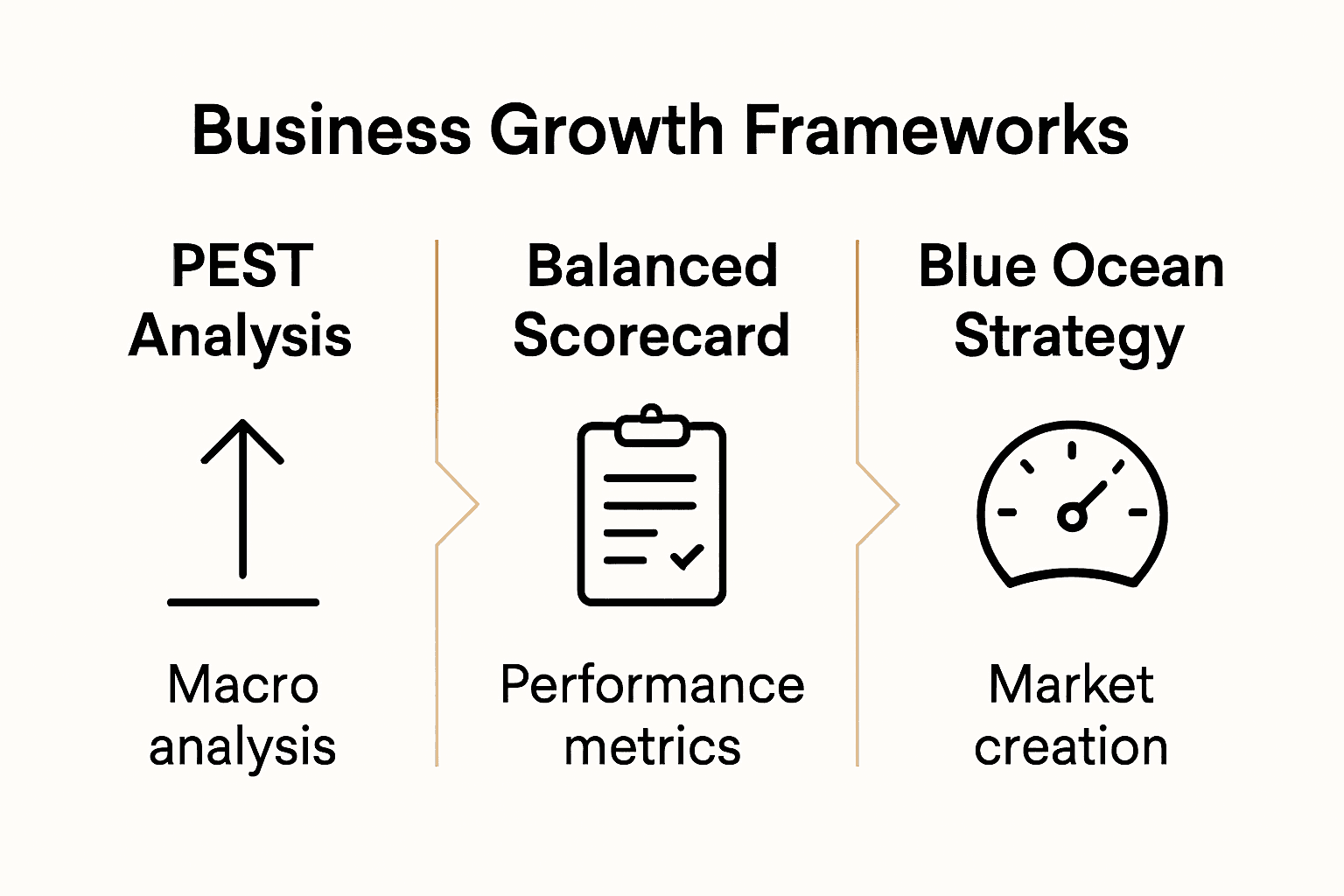
One powerful analytical tool is the PEST Analysis, which allows businesses to evaluate macro-environmental factors comprehensively. According to Wikipedia, this framework examines four critical dimensions: Political, Economic, Social, and Technological factors that might impact organizational performance. By systematically analyzing these external influences, companies can anticipate potential challenges and opportunities before they emerge.
The Economics of Strategy research provides additional insights into growth frameworks by highlighting key strategic principles. This approach emphasizes understanding fundamental economic concepts like economies of scale, transaction-cost economics, and market entry strategies. Entrepreneurs can leverage these principles to make more informed decisions about business expansion, resource allocation, and competitive positioning.
Some popular growth frameworks include:
- PEST Analysis: Macro-environmental scanning
- Balanced Scorecard: Holistic performance measurement
- Porter’s Five Forces: Competitive landscape assessment
- Blue Ocean Strategy: Creating uncontested market spaces
- Lean Startup Methodology: Rapid iteration and validated learning
For entrepreneurs seeking deeper understanding of implementing these transformative strategies, our business growth 2025 guide offers comprehensive insights into cutting-edge growth approaches tailored for modern business environments.
How Frameworks Drive Strategic Execution
Strategic execution transforms business strategies from theoretical concepts into actionable plans that generate real-world results. Frameworks serve as critical navigation tools that bridge the gap between strategic vision and practical implementation, providing entrepreneurs with structured methodologies to translate complex ideas into measurable outcomes.
According to the Integrated Management Concept, organizations can be understood as complex systems with interconnected sub-systems and functions. This perspective reveals how strategic frameworks facilitate effective execution by distinguishing between normative, strategic, and operational management dimensions. By breaking down organizational complexity into manageable components, businesses can design more precise and targeted execution strategies.
The concept of global value chains offers additional insights into strategic execution. Research from Global Value Chains and Development emphasizes the importance of strategic positioning and governance in driving business performance. Entrepreneurs can leverage these insights to understand how their organization fits within broader industry ecosystems and create more adaptive execution strategies.
Key mechanisms for driving strategic execution include:
- Clear performance metrics and accountability
- Cross-functional alignment and communication
- Continuous feedback and iterative improvement
- Flexible resource allocation
- Regular strategic reassessment
Entrepreneurs looking to enhance their strategic execution capabilities can explore our personal business growth guide for practical frameworks and actionable insights into transforming strategic vision into tangible business success.
Selecting the Right Framework for Your Business
Selecting an appropriate business growth framework represents a critical strategic decision that can significantly impact an organization’s trajectory. Entrepreneurs must approach this selection process with careful consideration, understanding that no single framework universally applies to every business context. The goal is to find a framework that aligns seamlessly with your unique organizational goals, market positioning, and operational capabilities.
According to research from DOAJ, a systematic comparative examination of strategic planning frameworks reveals the importance of integrating both conventional and innovative methodologies. This comprehensive approach helps practitioners select planning tools that are precisely tailored to contemporary business requirements, taking into account their practical significance, inherent advantages, and potential limitations.
Research on sustainable business models provides additional insights into framework selection. A study from arXiv classifies business models into fourteen unique categories, offering entrepreneurs a nuanced understanding of potential strategic approaches. This classification helps businesses identify frameworks that not only drive immediate growth but also ensure long-term sustainability and adaptability.
Key considerations when selecting a business growth framework include:
- Alignment with organizational goals and vision
- Flexibility and adaptability to changing market conditions
- Compatibility with existing organizational culture
- Measurable and trackable performance indicators
- Scalability across different business stages
Entrepreneurs seeking personalized guidance can explore our business growth 2025 guide for deeper insights into selecting and implementing the most effective growth frameworks for their specific business context.
Common Mistakes and Optimization Best Practices
Business growth frameworks are powerful tools, but their effectiveness depends entirely on thoughtful implementation and continuous refinement. Entrepreneurs often encounter significant challenges when attempting to translate strategic frameworks into actionable business processes, making it critical to understand potential pitfalls and develop robust optimization strategies.
Research from arXiv introduces a compelling perspective on innovation in strategic networks, emphasizing the need to move beyond traditional linear models. The study highlights a critical insight: successful businesses must adopt dynamic, evolutionary mechanisms rather than rigid, predetermined approaches. This means embracing flexibility and continuously adapting frameworks to changing market conditions, rather than treating strategic plans as static documents.
Additional research exploring strategic management through advanced technologies offers fascinating insights. According to arXiv, emerging approaches using large language models can help businesses extract and organize strategic data more effectively. This technological approach provides entrepreneurs with sophisticated tools for analyzing and optimizing their growth frameworks, demonstrating how cutting-edge technologies can enhance traditional strategic planning methods.
Common mistakes entrepreneurs should avoid include:
- Treating frameworks as rigid, unchangeable blueprints
- Neglecting regular performance reviews and adjustments
- Failing to align frameworks with actual market dynamics
- Overlooking team input and organizational culture
- Implementing frameworks without clear metrics
Entrepreneurs seeking to refine their strategic approach can explore our personal business growth guide for comprehensive insights into developing adaptive, responsive business growth strategies.
Accelerate Your Business Growth with Expert Guidance and Community Support
Navigating the complex world of business growth frameworks can feel overwhelming. You might be struggling with selecting the right strategies, aligning your goals, or turning theory into action while adapting to changing markets. This guide highlights key challenges like strategic execution, customer-centric growth, and flexibility — all critical elements where many entrepreneurs seek clarity and support.
At Nomad Excel, we understand these pain points deeply. Our Entrepreneurship Archives offer rich insights while our immersive bootcamps provide step-by-step frameworks combined with hands-on mentorship. You gain daily accountability, scalable systems, and an energized peer community that pushes you beyond roadblocks. For startups and teams ready to transform ideas into measurable growth, explore our complete programs at Nomad Excel. Dive deeper into practical frameworks and build your business with confidence by visiting the Program Archives.
Take control of your growth journey today. Learn, execute, and connect with driven entrepreneurs who share your vision and challenges. Visit Nomad Excel now and turn business growth frameworks into your competitive advantage.
Frequently Asked Questions
What are business growth frameworks?
Business growth frameworks are strategic roadmaps that help entrepreneurs transform innovative ideas into sustainable, scalable enterprises. They provide systematic methods for analyzing opportunities, developing strategies, and driving organizational expansion.
How can I select the right framework for my business?
To select the right framework, consider factors such as alignment with your organizational goals, flexibility to adapt to market changes, compatibility with existing culture, trackable performance indicators, and scalability across different business stages.
What are some common mistakes in implementing growth frameworks?
Common mistakes include treating frameworks as rigid blueprints, neglecting performance reviews, failing to align frameworks with market dynamics, overlooking team input, and implementing frameworks without clear success metrics.
How do frameworks drive strategic execution in business?
Frameworks bridge the gap between strategic vision and practical implementation by providing structured methodologies that help translate complex ideas into measurable outcomes, enabling effective execution across various organizational components.
Recommended
- Personal Business Growth: Complete Guide for Entrepreneurs – Nomad Excel – Your Entrepreneurial Adventure Starts Here
- Business Growth in 2025: The Essential Guide – Nomad Excel – Your Entrepreneurial Adventure Starts Here
- What Is Business Ideation? Complete Expert Guide – Nomad Excel – Your Entrepreneurial Adventure Starts Here
- Outdoor Group Games For Adults Perfect for Team Building
Comments are closed.