
Business Growth Strategy Workflow for Fast Results
Over 85 percent of american businesses struggle to turn ambitious growth plans into real, measurable results. Without clear objectives and a structured approach, even the most promising ideas can stall before gaining traction. Understanding how to define, analyze, and execute on strategic growth steps can make all the difference, helping you transform challenges into opportunities for ongoing success.
Table of Contents
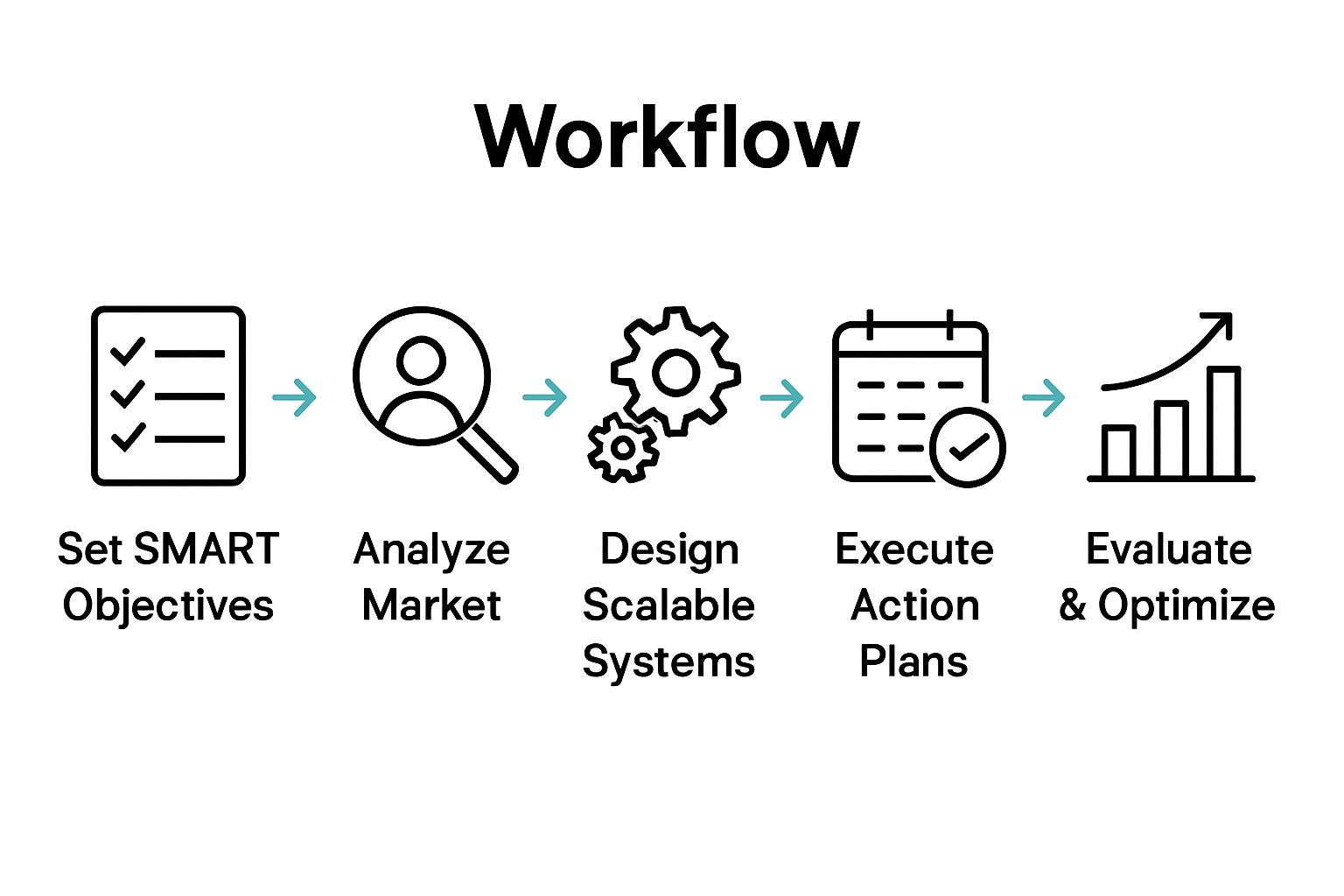
- Step 1: Define Measurable Growth Objectives
- Step 2: Analyze Your Target Market And Opportunities
- Step 3: Design Scalable Business Systems And Offers
- Step 4: Execute Focused Action Plans With Accountability
- Step 5: Evaluate Progress And Optimize Strategies
Quick Summary
| Key Insight | Explanation |
|---|---|
| 1. Set SMART growth objectives | Define growth targets that are Specific, Measurable, Achievable, Relevant, and Time-bound to guide progress effectively. |
| 2. Conduct thorough market analysis | Understand customer personas and competition to identify gaps and opportunities for your business in the market. |
| 3. Design adaptable systems | Create scalable business processes and offerings that can evolve with market demands to achieve sustainable growth. |
| 4. Implement accountability measures | Break down strategies into actionable steps with clear roles and regular check-ins to maintain team alignment and focus. |
| 5. Regularly evaluate and optimize | Continuously assess performance metrics and gather feedback to adjust strategies according to market conditions. |
Step 1: Define measurable growth objectives
Defining clear and actionable growth objectives is the strategic foundation for transforming your business vision into tangible results. This crucial step helps you create a roadmap that converts ambitious goals into achievable milestones.
According to the International Finance Corporation, successful business growth requires establishing objectives across multiple dimensions. Start by identifying specific areas for development such as market position, innovation, productivity, profitability, and team capabilities. Break down each dimension into quantifiable targets that provide a clear picture of progress.
Begin by conducting thorough market research to understand your current position and potential opportunities. American Public University emphasizes that market research helps uncover emerging trends and consumer behaviors critical for informed decision making. Your objectives should follow the SMART framework: Specific, Measurable, Achievable, Relevant, and Time bound.
Pro Tip: Create objectives that are ambitious yet realistic. Overly aggressive targets can demotivate your team, while overly conservative goals limit potential growth.
Once you have defined your objectives, the next step is developing a strategic implementation plan that transforms these goals from abstract concepts into actionable strategies.
Step 2: Analyze your target market and opportunities
Analyzing your target market is a strategic exercise that reveals critical insights into potential growth pathways and competitive positioning. This step transforms raw market data into actionable intelligence that guides your business strategy.
According to EESBAC, a structured approach to market analysis requires examining your existing customer base while simultaneously exploring new market segments. Start by developing comprehensive customer personas that capture demographic information, behavioral patterns, purchasing motivations, and unmet needs. This deep understanding allows you to identify gaps in current market offerings where your business can provide unique value.
The Journal of Research and Development emphasizes the importance of comprehensive competitive analysis. Research your competitors thoroughly examining their strengths, weaknesses, pricing strategies, and market positioning. Look for opportunities where competitors are underserving specific customer segments or where technological shifts are creating new market niches.
Pro Tip: Use both quantitative data like market size and growth rates, and qualitative insights from customer interviews to build a nuanced market understanding.
Once you have mapped your market landscape, you will be ready to develop targeted strategies that align your business capabilities with market opportunities.

Step 3: Design scalable business systems and offers
Designing scalable business systems and offers is about creating flexible, adaptable solutions that can grow and evolve with your business. This critical step transforms your market insights into strategic frameworks that support sustainable expansion and consistent value delivery.
According to University of Maryland’s Online Master of Science in Management Studies, effective business system design requires a strategic approach that balances structure with flexibility. Begin by mapping out your core business processes and identifying potential bottlenecks or inefficiencies that could limit growth. Focus on creating modular systems that can be easily adjusted as your market demands change.
Start by developing standardized yet adaptable service or product offerings that can be quickly customized for different market segments. This might involve creating core service packages with optional add ons or developing technology platforms that allow for rapid iteration. Prioritize automation and digital tools that can help you scale operations without proportionally increasing your labor costs. Look for opportunities to implement repeatable workflows that maintain quality while reducing manual intervention.
Pro Tip: Build scalability into your initial design. It is far easier to create flexible systems from the start than to retrofit existing processes later.
Once you have designed your scalable systems, you will be prepared to develop a strategic implementation plan that turns these frameworks into actionable business growth strategies.
Step 4: Execute focused action plans with accountability
Executing focused action plans with accountability transforms strategic vision into measurable progress. This critical step bridges the gap between planning and actual business growth by creating a structured approach to implementation that keeps your team aligned and motivated.
American Public University emphasizes that effective execution requires clear insights into market dynamics and consumer behavior. Break down your overall strategy into specific quarterly and monthly objectives with precise metrics and measurable outcomes. Create a detailed tracking system that allows you to monitor progress in real time and quickly adjust strategies when performance deviates from expected results.
According to the Robert H. Smith School of Business, successful implementation involves establishing clear accountability mechanisms. Assign specific responsibilities to team members with explicit performance expectations. Implement weekly or biweekly check ins where each team member reports on their progress, challenges, and next steps. Use project management tools that provide transparency and allow for real time collaboration and tracking.
Pro Tip: Develop a culture of radical transparency where team members feel comfortable discussing obstacles and requesting support without fear of negative consequences.
By creating a robust execution framework with clear accountability, you set the stage for consistent and measurable business growth.
Step 5: Evaluate progress and optimize strategies
Evaluating progress and optimizing strategies is the critical ongoing process that transforms your business from static planning to dynamic growth. This step ensures your business remains agile, responsive, and continuously improving based on real world performance and market insights.
The International Finance Corporation emphasizes the importance of developing precise Key Performance Indicators (KPIs) that provide clear and measurable insights into your business performance. Select metrics that go beyond surface level numbers and capture the nuanced aspects of your strategic objectives. These KPIs should be specific enough to offer genuine insights while being comprehensive enough to reflect your overall business health.
American Public University highlights that effective strategy optimization requires continuous market research to understand emerging trends and shifting consumer behaviors. Conduct quarterly strategic reviews where you analyze your KPIs, gather team feedback, and reassess market conditions. Be prepared to make incremental adjustments or even pivot more dramatically if your current approach is not delivering expected results.
Pro Tip: Create a learning culture where strategy optimization is seen as an opportunity for growth rather than a criticism of past performance.
By implementing a systematic approach to evaluation and optimization, you transform your business strategy from a static document into a living, adaptive framework for sustained success.
Accelerate Your Business Growth with Expert Support and Community
If you found this guide on building a business growth strategy workflow insightful but feel overwhelmed by turning your objectives into consistent, measurable results, you are not alone. Many entrepreneurs struggle with clarity in defining goals, executing focused action plans, and adapting strategies as markets shift. This is where Nomad Excel steps in to help. Our Entrepreneurship Archives offer practical frameworks and mentorship that guide you through designing scalable systems and holding your team accountable for rapid progress.
Join us at Nomad Excel where you can participate in immersive bootcamps and retreats designed specifically to help you take immediate action on your business vision. Benefit from expert mentorship, a supportive community, and a proven process that turns strategic ideas into real growth. Take the next step today by exploring our Business Archives and discover how fast you can get results with the right guidance and execution blueprint.
Frequently Asked Questions
How can I define clear growth objectives for my business?
To define clear growth objectives, start by identifying specific areas for development such as market position and team capabilities, then apply the SMART framework: Specific, Measurable, Achievable, Relevant, and Time bound. Create a list of quantifiable targets that align with your overall business vision to ensure they are actionable.
What steps do I take to analyze my target market effectively?
Begin your market analysis by developing comprehensive customer personas to capture key demographic and behavioral details. Research your competitors thoroughly to identify gaps and opportunities where your business can offer unique value.
How can I design scalable business systems that support growth?
To design scalable business systems, map out your core business processes and identify inefficiencies. Focus on creating modular and automated systems that can be easily adjusted to meet changing market demands and that help maintain quality while reducing labor costs.
What should I include in my action plans to ensure effective execution?
Your action plans should break down your growth strategy into specific monthly and quarterly objectives with clear metrics for success. Assign responsibilities to team members and establish regular check-ins to monitor progress, allowing for adjustments as needed to stay on track.
How often should I evaluate my business progress and optimize strategies?
Regularly evaluate your progress at least quarterly to analyze your performance metrics and gather team feedback. Use these evaluations to make incremental adjustments to your strategies based on real-world results and market conditions, aiming for continuous improvement.
Recommended
- Complete Guide to Business Growth Frameworks
- Business Growth in 2025: The Essential Guide – Nomad Excel – Your Entrepreneurial Adventure Starts Here
- Personal Business Growth: Complete Guide for Entrepreneurs – Nomad Excel – Your Entrepreneurial Adventure Starts Here
- Outdoor Group Games For Adults Perfect for Team Building
Comments are closed.