
Role of Community Support in Entrepreneur Success
Nearly 90 percent of early-stage founders admit to feeling isolated, and even the most resourceful American entrepreneur faces this challenge in the global business world. Building a company from scratch often means you must make tough decisions on your own, but community support can change everything. This article explores how leveraging relationships and diverse knowledge networks helps aspiring entrepreneurs overcome uncertainty and access the strategic insight they need to grow with confidence.
Table of Contents
- Defining Community Support In Entrepreneurship
- Types Of Entrepreneurial Support Networks
- Key Benefits For Early-Stage Founders
- Risks And Common Pitfalls To Avoid
- Leveraging Community For Long-Term Success
Key Takeaways
| Point | Details |
|---|---|
| Community Support is Multifaceted | Effective community support involves structured systems of knowledge sharing, mentorship, and networking that are essential for entrepreneurial success. |
| Diverse Support Networks are Crucial | Engaging with various network types—personal, professional, industry-specific, and institutional—maximizes resources and strategic insights for entrepreneurs. |
| Risks in Community Engagement Exist | Founders must be cautious of superficial connections and groupthink, ensuring they verify advice and diversify their network quality. |
| Long-Term Community Engagement is Key | Sustainable success relies on intentional investments in relationships and consistent knowledge exchange within entrepreneurial ecosystems. |
Defining Community Support in Entrepreneurship
Community support in entrepreneurship represents a multifaceted ecosystem of collaborative relationships, resources, and strategic interactions that empower founders to navigate complex business challenges. More than simple emotional encouragement, this framework involves structured systems of knowledge sharing, network building, and collective problem solving that significantly impact entrepreneurial success.
At its core, community support encompasses complex and multi-layered interactions that influence entrepreneurial outcomes. These interactions are not merely transactional but deeply relational, involving mentorship, peer feedback, resource exchange, and collective learning. Entrepreneurs benefit from connections that provide emotional validation, practical advice, professional networking, and access to diverse perspectives that challenge and refine their business strategies.
Beyond individual interactions, community support represents a transformative approach to entrepreneurial development. Research indicates that robust entrepreneurial communities are built on cooperative relationships, emphasizing social benefits and collective value creation. Such communities function as dynamic ecosystems where knowledge flows freely, risks are shared, and individual successes contribute to broader economic and social progress. These support networks transcend traditional mentorship models by creating interconnected environments where entrepreneurs can experiment, learn from failures, and accelerate their growth through shared experiences.
Pro Tip: Actively seek out entrepreneurial communities that offer structured networking opportunities, not just social connections, to maximize your professional growth and strategic potential.
Types of Entrepreneurial Support Networks
Entrepreneurial support networks represent diverse ecosystems designed to provide targeted assistance for founders at different stages of business development. These networks range from formal institutional structures to informal collaborative platforms, each offering unique resources, mentorship opportunities, and strategic connections that can significantly impact an entrepreneur’s trajectory.
Systematic research examining Entrepreneurial Support Organizations (ESOs) reveals a complex taxonomy of support structures, including specialized entities like business incubators, accelerators, pre-incubators, and professional networking groups. Each network type has distinct characteristics: incubators typically provide physical workspace and foundational business support, accelerators focus on rapid growth and investment readiness, while professional networks offer peer connections and knowledge exchange. These varied networks serve different entrepreneurial needs, helping founders navigate challenges through tailored resources and expertise.
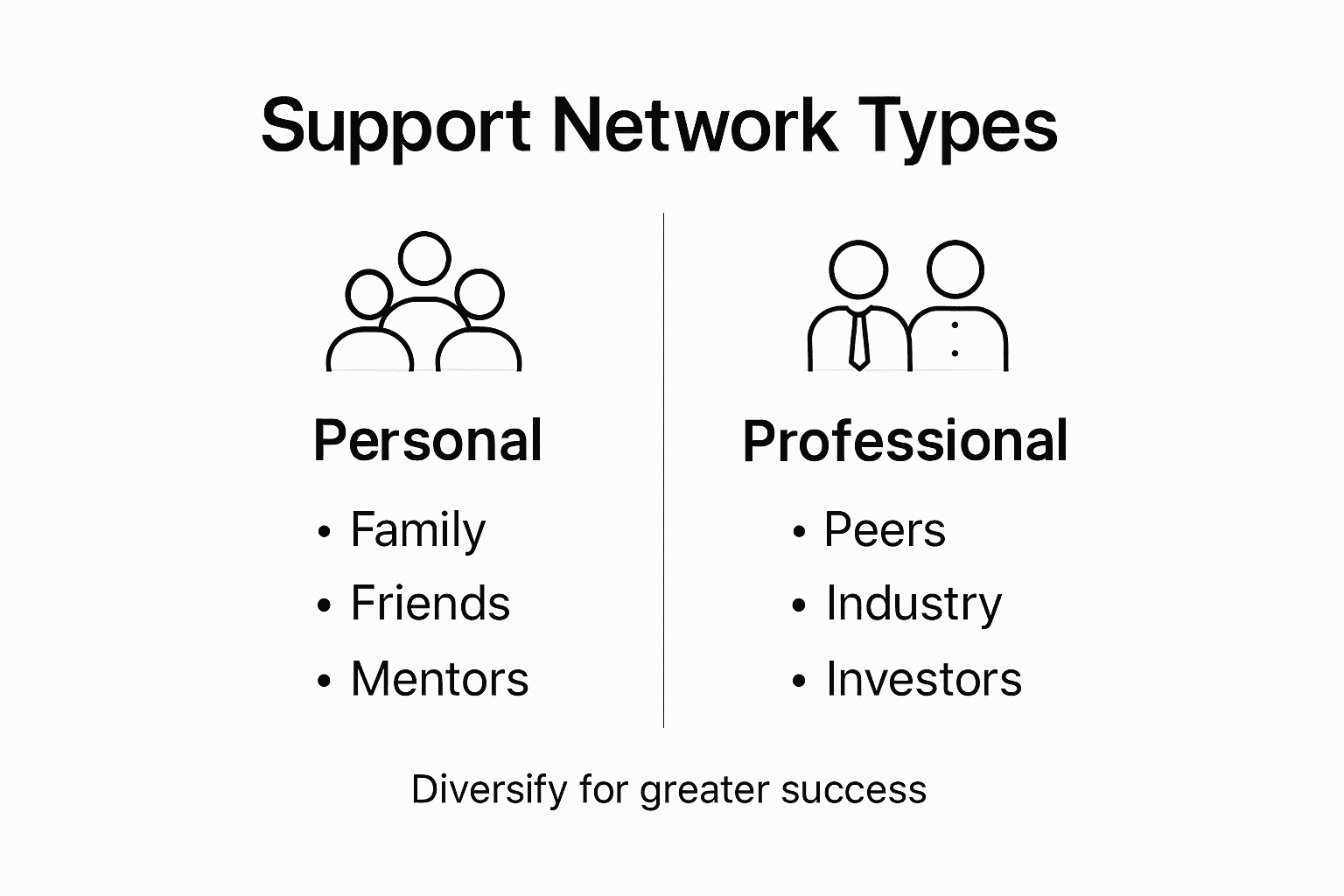
The composition of entrepreneurial support networks can be categorized into several key types: personal networks, professional networks, industry-specific networks, and institutional networks. Research demonstrates that these networks differ significantly in their impact on opportunity identification and strategic decision-making. Personal networks often provide emotional support and initial feedback, professional networks offer skill development and career opportunities, industry-specific networks deliver targeted insights and trend information, while institutional networks connect entrepreneurs with formal resources like funding, legal guidance, and advanced training programs.
Here’s a concise comparison of major types of entrepreneurial support networks and their unique contributions:
| Network Type | Primary Benefit | Best For Stage |
|---|---|---|
| Personal Networks | Emotional resilience, feedback | Idea/early-stage |
| Professional Networks | Skill development, connections | Growth/expansion |
| Industry-Specific | Market insights, trends | Scaling |
| Institutional Networks | Funding, legal, advanced help | All stages |
Pro Tip: Diversify your entrepreneurial support network by actively engaging with multiple network types to gain comprehensive insights and maximize your business growth potential.
Key Benefits for Early-Stage Founders
Early-stage founders face numerous challenges that can significantly impact their entrepreneurial journey, making strategic community support essential for survival and growth. These support networks offer far more than simple encouragement, providing critical resources, insights, and opportunities that can transform nascent business ideas into sustainable ventures.
Empirical research exploring founders’ personal and business networks reveals substantial advantages in accessing capital and strategic guidance. Diverse connection networks enable early-stage entrepreneurs to navigate complex funding landscapes, develop robust fundraising strategies, and secure crucial initial investments. By leveraging both personal relationships and professional connections, founders can create a comprehensive support ecosystem that addresses financial, strategic, and emotional challenges simultaneously.

Global research into entrepreneurial ecosystems highlights the profound impact of peer learning and relationship building for early-stage founders. These support networks provide critical benefits including knowledge exchange, emotional resilience, collaborative problem solving, and opportunities to combat entrepreneurial isolation. Key advantages include accessing real-world insights from experienced entrepreneurs, receiving constructive feedback, developing professional skills through shared experiences, and building valuable reputational capital within their industry. Early-stage founders who actively engage with supportive networks demonstrate increased adaptability, faster learning curves, and higher potential for sustainable business growth.
Pro Tip: Intentionally cultivate diverse relationships across different entrepreneurial networks, prioritizing quality connections that offer genuine learning and strategic value over superficial networking.
Risks and Common Pitfalls to Avoid
Entrepreneurial community support offers immense potential, but navigating these networks requires strategic awareness and critical discernment. Not all support systems are created equal, and founders must develop a nuanced approach to maximize benefits while mitigating potential risks inherent in collaborative ecosystems.
Comprehensive research analyzing entrepreneurial barriers reveals critical risks associated with over-reliance on community support. Common pitfalls include network saturation, inconsistent mentorship quality, and a dangerous tendency to mistake social connections for substantive strategic guidance. Founders must critically evaluate the depth and authenticity of their support networks, recognizing that superficial interactions can create false sense of progress while potentially obscuring genuine business challenges.
Academic reviews of entrepreneurial ecosystems highlight significant operational, legal, and technological vulnerabilities that can emerge from community-driven models. These risks encompass regulatory compliance challenges, potential data protection issues, and increased susceptibility to external disruptions. Successful entrepreneurs recognize that community support should complement, not replace, rigorous individual research, professional expertise, and independent decision-making. Critical areas of potential vulnerability include unchecked advice acceptance, groupthink dynamics, and an overemphasis on networking at the expense of focused business development.
Below is a summary highlighting major risks in entrepreneurial community support and strategic actions to manage them:
| Risk | Impact Example | How to Mitigate |
|---|---|---|
| Superficial connections | False sense of progress | Prioritize quality ties |
| Groupthink | Missed opportunities | Welcome diverse views |
| Unchecked advice | Costly business mistakes | Verify with experts |
| Overemphasis on networking | Neglected business execution | Set goals for outreach |
Pro Tip: Implement a systematic evaluation process for your entrepreneurial network, regularly assessing the tangible value, expertise level, and strategic alignment of each connection.
Leveraging Community for Long-Term Success
Successful entrepreneurs understand that community engagement is not a temporary strategy but a fundamental approach to sustainable business growth. Building enduring connections requires intentional, strategic investment in relationships that extend far beyond casual networking, transforming professional interactions into powerful collaborative ecosystems.
Research demonstrates that long-term entrepreneurial success is intricately linked to five strategic community roles: vision setting, resource management, networking, innovation leadership, and strategic collaboration. Entrepreneurs who masterfully integrate these dimensions create resilient ventures capable of adapting to complex market dynamics. By continuously engaging with diverse networks, founders can access critical insights, challenge their assumptions, and develop more robust business strategies that transcend individual limitations.
Sustainable entrepreneurship research highlights the symbiotic relationship between collaborative knowledge sharing and long-term business resilience. Successful founders recognize that community engagement is not just about immediate benefits but about creating interconnected ecosystems that foster continuous learning, innovation, and collective problem solving. This approach enables entrepreneurs to mitigate risks, access emerging opportunities, and develop adaptive strategies that respond dynamically to changing business landscapes.
Pro Tip: Develop a systematic approach to community engagement by scheduling regular knowledge exchange sessions, maintaining diverse connections, and actively contributing value to your professional networks.
Unlock the Power of Community Support to Accelerate Your Entrepreneurial Journey
Launching or scaling a business comes with complex challenges like finding meaningful mentorship, accessing diverse resources, and building resilient networks that go beyond superficial connections. This article highlights how strategic community support can transform these challenges into growth opportunities by providing emotional resilience, expert guidance, and collaborative problem solving that early-stage founders desperately need.
At Nomad Excel, we understand that success depends on more than just hard work. Our immersive entrepreneurship bootcamps are designed to create exactly the kind of dynamic, supportive ecosystem described here. Through hands-on learning, personalized mentorship, and a driven peer community, you develop actionable skills and confident clarity that multiply your chances for lasting success. Whether you want to launch your first venture or scale an existing one, our programs connect you with focused experts and ambitious founders who will challenge your ideas and fuel your progress.
Ready to move beyond isolation and superficial networking? Visit Nomad Excel today and explore our program Archives to join a community where collaboration leads to real-world execution and sustainable growth. Turn supportive networks into your competitive advantage now.
Frequently Asked Questions
What is community support in entrepreneurship?
Community support in entrepreneurship refers to a network of collaborative relationships, knowledge sharing, and strategic interactions that empower business founders to tackle challenges and enhance their success.
How can early-stage founders benefit from community support?
Early-stage founders gain critical resources, insights, and networking opportunities through community support, which can help them secure funding, develop skills, and overcome isolation in their entrepreneurial journey.
What are the main types of entrepreneurial support networks?
The main types of entrepreneurial support networks include personal networks, professional networks, industry-specific networks, and institutional networks, each providing unique benefits and resources tailored to different stages of business development.
What risks should entrepreneurs be aware of when seeking community support?
Entrepreneurs should be cautious of superficial connections, groupthink dynamics, and over-reliance on advice from their networks, which can lead to misguided strategies and hinder their business decision-making.
Recommended
- Why Community Supports Entrepreneurs’ Growth and Success
- How to Build Business Community for Entrepreneurs
- Why Join Entrepreneur Communities: Growth Through Connection
- What Is Entrepreneurial Community? Complete Breakdown – Nomad Excel – Your Entrepreneurial Adventure Starts Here
- Understanding Social Media Marketing Guide for Businesses – Jarrod Harman
Comments are closed.