
Startup Bootcamp Structure: Pathways to Real Growth
Startup bootcamps have reshaped how American entrepreneurs tackle the early stages of business creation. With over 70 percent of startups failing due to a lack of real-world experience, these intensive programs offer practical solutions that traditional education rarely provides. Bootcamps accelerate learning through hands-on skill building and powerful community connections, helping founders turn bright ideas into viable businesses much faster and smarter.
Table of Contents
- Defining Startup Bootcamps And Core Concepts
- Types Of Startup Bootcamp Programs Worldwide
- Key Components: Phases, Mentorship, And Community
- Participant Journey And Learning Milestones
- Critical Success Factors And Common Pitfalls
Key Takeaways
| Point | Details |
|---|---|
| Startup Bootcamps Accelerate Growth | These structured programs enhance entrepreneurial development by combining education, hands-on skills, and networking opportunities in a high-intensity environment. |
| Diverse Program Types Cater to Various Needs | Bootcamps vary from technology-focused to industry-specific, providing tailored pathways that empower different entrepreneur profiles. |
| Mentorship and Community are Essential | Expert guidance and peer networks bolster learning, fostering lasting relationships that support participants beyond the program. |
| Success Depends on Adaptability and Feedback | Entrepreneurs must embrace flexibility and constructive criticism to navigate challenges and ensure their initiatives thrive. |
Defining Startup Bootcamps and Core Concepts
Startup bootcamps represent intensive, structured learning environments designed to accelerate entrepreneurial growth by combining targeted education, hands-on skill development, and strategic networking opportunities. These programs are meticulously crafted to transform aspiring entrepreneurs from concept stage to actionable business models through immersive, high-intensity experiences.
At their core, startup bootcamps provide a concentrated ecosystem where early-stage founders can rapidly prototype business strategies within a compressed timeframe. Recent academic research highlights the critical role of structured learning environments in startup development. Systematic mapping of software development practices reveals that targeted educational interventions can significantly enhance entrepreneurial capabilities and reduce common founding mistakes.
The fundamental architecture of a startup bootcamp typically involves several key components. Structured learning modules focus on essential skills such as market validation, product design, financial modeling, and pitch preparation. These modules are complemented by mentorship sessions where experienced entrepreneurs provide direct guidance, helping participants navigate complex business challenges. Additionally, bootcamps create powerful peer networks that extend beyond the program, enabling ongoing collaboration and support.
Understanding the entrepreneurial journey requires recognizing that traditional education often falls short in preparing founders for real-world challenges. Entrepreneurship bootcamps bridge this critical gap by providing an immersive, action-oriented approach to business creation. By combining theoretical knowledge with practical execution, these programs empower founders to transform innovative ideas into sustainable, scalable ventures through intensive, focused training and community-driven learning experiences.
Types of Startup Bootcamp Programs Worldwide
Startup bootcamp programs have evolved into a diverse global ecosystem, offering entrepreneurs multiple pathways for accelerated business development. Global entrepreneurship support initiatives now span 125 countries, reflecting the increasing demand for structured, intensive learning experiences that bridge traditional education and real-world business challenges.

These programs can be broadly categorized into several distinct models. Technology-focused bootcamps prioritize digital innovation, targeting software developers, tech entrepreneurs, and digital product creators. Industry-specific bootcamps concentrate on specialized sectors like fintech, healthcare technology, and sustainable energy, providing deep domain expertise. General entrepreneurship bootcamps offer comprehensive training applicable across multiple business domains, helping founders develop foundational skills in strategy, marketing, financial planning, and team building.
Top educational bootcamp startups demonstrate remarkable diversity in their approach and focus. Some programs are intensive residential experiences lasting 4-12 weeks, while others offer hybrid or fully online formats. Key variations include:
- Accelerator-style bootcamps: Provide seed funding, mentorship, and direct investor connections
- Academic institution bootcamps: University-affiliated programs with rigorous curriculum and research support
- Corporate-sponsored bootcamps: Designed by major tech companies to nurture entrepreneurial talent
- Community-driven bootcamps: Focus on peer learning and collaborative problem-solving
The global landscape of startup bootcamps continues to expand, driven by the recognition that traditional educational models often fail to prepare entrepreneurs for rapid technological change and complex market dynamics. These programs serve as critical bridges, transforming innovative ideas into actionable business strategies through immersive, practical learning experiences.
Key Components: Phases, Mentorship, and Community
Startup bootcamps are meticulously structured experiences that transform entrepreneurial potential through carefully designed phases, strategic mentorship, and powerful community dynamics. Comprehensive entrepreneurial programs typically unfold across a structured 14-week journey, guiding founders through critical stages of business development.
The program phases represent a strategic progression designed to systematically build entrepreneurial capabilities. Initial stages focus on idea validation, where participants rigorously test and refine business concepts. Subsequent phases transition into product development, helping founders prototype minimum viable products and develop compelling pitch strategies. Startup mentorship programs play a crucial role during these transitions, providing targeted guidance that bridges theoretical knowledge with practical execution.
Mentorship emerges as a cornerstone of effective bootcamp experiences. Expert mentors bring deep industry insights, offering personalized feedback that helps founders navigate complex business challenges. These relationships extend beyond formal program hours, creating lasting professional connections. The community aspect further amplifies learning through:
- Peer-to-peer knowledge exchange
- Collaborative problem-solving sessions
- Networking opportunities with potential investors
- Shared accountability mechanisms
- Cross-pollination of innovative ideas
Ultimately, successful startup bootcamps integrate three critical elements: structured learning phases, experienced mentorship, and a dynamic entrepreneurial community. These components work synergistically to transform individual potential into scalable, sustainable business ventures, providing founders with the strategic toolkit necessary to thrive in competitive market landscapes.
Participant Journey and Learning Milestones
The entrepreneurial journey through startup bootcamps represents a transformative experience where participants progress through carefully designed learning milestones. Innovative training programs demonstrate how structured 10-week online curricula can systematically develop entrepreneurial capabilities across multiple dimensions.
Initial Discovery Phase focuses on fundamental skill building and personal assessment. Participants engage in deep self-reflection, identifying their unique strengths, market opportunities, and potential business concepts. Project-based learning approaches emphasize hands-on skill development, enabling founders to translate theoretical knowledge into practical entrepreneurial strategies. Key milestones during this stage include:
- Personal strengths and capability assessment
- Initial business concept generation
- Market opportunity identification
- Basic entrepreneurial skill development
- Individual and team potential evaluation
Subsequent phases transition into more intensive skill development and execution. Validation and Prototype Stages challenge participants to rigorously test their business hypotheses, develop minimum viable products, and refine their strategic approaches. Entrepreneurs learn to pivot quickly, embrace failure as a learning opportunity, and develop resilient problem-solving capabilities that extend far beyond the bootcamp experience.
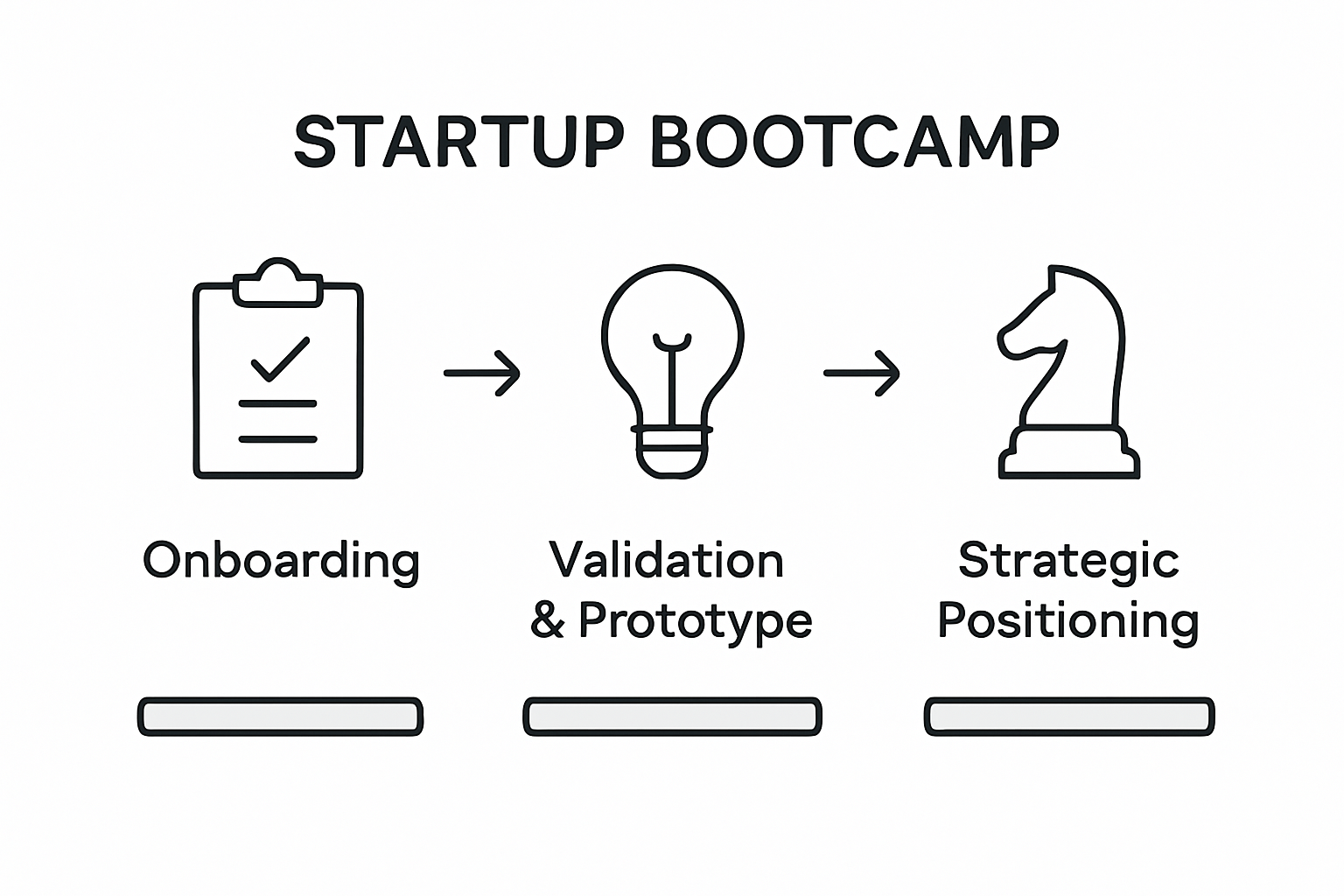
The final stage of the participant journey centers on strategic positioning and future preparation. Participants develop comprehensive business plans, refine pitch presentations, and build networks that will support their entrepreneurial endeavors long after the program concludes. This holistic approach transforms individual potential into actionable business strategies, equipping founders with the knowledge, skills, and connections necessary to navigate complex entrepreneurial landscapes.
Critical Success Factors and Common Pitfalls
Startup engineering practices reveal that success in entrepreneurial bootcamps hinges on more than just innovative ideas—it requires strategic execution, adaptable mindsets, and a nuanced understanding of complex business dynamics. Entrepreneurs who navigate these programs successfully demonstrate remarkable resilience and strategic thinking.
The critical success factors emerge from a combination of personal attributes and strategic approaches. Effectual logic in software startups emphasizes the importance of flexible problem-solving and iterative development. Key elements that distinguish successful participants include:
- Rapid learning and adaptation skills
- Openness to constructive feedback
- Ability to pivot quickly
- Strong network building capabilities
- Disciplined yet creative thinking
Conversely, common pitfalls can derail even the most promising entrepreneurial journeys. Participants frequently struggle with:
- Overattachment to initial business concepts
- Insufficient market validation
- Inadequate financial planning
- Poor communication within teams
- Resistance to mentorship and external guidance
Ultimately, success in startup bootcamps requires a delicate balance between passionate commitment and strategic flexibility. Entrepreneurs who approach these programs with humble curiosity, analytical rigor, and a willingness to continuously reinvent their strategies are most likely to transform potential challenges into meaningful business opportunities.
Accelerate Your Entrepreneurial Journey with Nomad Excel
Navigating the complex phases of a startup bootcamp can be challenging for many founders. The need for structured learning, strategic mentorship, and a supportive community is clear. If you find yourself struggling with idea validation, building scalable systems, or seeking guidance to pivot confidently, you are not alone. Startup bootcamps demand rapid execution and adaptability to avoid common pitfalls like overattachment to initial concepts or inadequate market validation.
At Nomad Excel, we specialize in turning these challenges into growth opportunities. Our immersive entrepreneurship bootcamps combine step-by-step business building frameworks, expert mentorship, and a dynamic community atmosphere designed to help you refine your strategy, boost execution skills, and build lasting networks. Explore our Program Archives to discover how our curated, action-oriented experiences can align perfectly with the pathways to real growth discussed in this article. Ready to transform your startup potential into measurable success Take the first step today by visiting Nomad Excel and uncover how our unique approach fosters clarity, mentorship, and execution at every phase of your entrepreneurial adventure. For ongoing inspiration and insights that keep you connected to the startup ecosystem, visit our Inspiration Archives. Start growing faster now with Nomad Excel.
Frequently Asked Questions
What is the purpose of a startup bootcamp?
Startup bootcamps are designed to accelerate entrepreneurial growth by providing structured education, hands-on skill development, and networking opportunities that help aspiring entrepreneurs turn their concepts into actionable business models.
What are the key components of a startup bootcamp?
Key components of a startup bootcamp include structured learning modules, mentorship sessions from experienced entrepreneurs, and the development of a strong peer network to facilitate ongoing collaboration and support.
How do startup bootcamps help with market validation?
Startup bootcamps focus on essential skills such as market validation, where participants rigorously test and refine their business concepts to ensure there is a viable market for their product or service before moving to the development stage.
What challenges do entrepreneurs face in startup bootcamps?
Common challenges include overattachment to initial business concepts, insufficient market validation, inadequate financial planning, and resistance to mentorship, which can hinder their ability to effectively navigate the entrepreneurial journey.
Comments are closed.