
What Is Early-Stage Entrepreneurship? Complete Guide
Did you know that nearly 90 percent of startups never make it past their early years? This stage is where dreams meet reality and every decision can shape the future of a new business. For entrepreneurs, understanding the essentials of early-stage development, mastering the skills needed to lead, and navigating challenges head-on can set the foundation for long-term success.
Table of Contents
- Defining Early-Stage Entrepreneurship
- Key Stages And Milestones For Startups
- Common Business Models And Approaches
- Essential Skills And Traits For Founders
- Challenges, Risks, And Common Pitfalls
Key Takeaways
| Key Point | Details |
|---|---|
| Early-Stage Definition | Represents the transition from idea to functioning enterprise, involving market identification and securing funding. |
| Development Stages | Startups follow stages: inception, stabilization, growth, and maturity, each with unique challenges and focuses. |
| Essential Skills | Founders require resilience, decisive leadership, and adaptability to navigate the complexities of early-stage entrepreneurship. |
| Overcoming Challenges | Entrepreneurs must manage financial constraints, market alignment, and operational inefficiencies to position their startups for success. |
Defining Early-Stage Entrepreneurship
Early-stage entrepreneurship represents a dynamic and transformative period where individuals transition from having a business concept to actively building a functional enterprise. According to ebsco, this phase involves critical activities like identifying market opportunities, developing comprehensive business plans, and securing initial funding.
Entrepreneurial Characteristics at this stage typically include:
- Transforming innovative ideas into viable products or services
- Navigating significant market uncertainties
- Establishing foundational business structures
- Managing limited resources strategically
As defined by scribd, early-stage entrepreneurs are individuals owning and managing a nascent business that has not been operational for more than 42 months. This period is crucial, encompassing multiple key developmental milestones such as concept validation, initial market entry, and implementing early growth strategies.
The entrepreneurial journey during this phase requires exceptional adaptability, resilience, and strategic thinking. Entrepreneurs must simultaneously wear multiple hats – from product developer and marketer to financial manager and team builder. Success depends not just on the innovative idea, but on the ability to execute effectively and respond quickly to emerging market dynamics.
Key Stages and Milestones for Startups
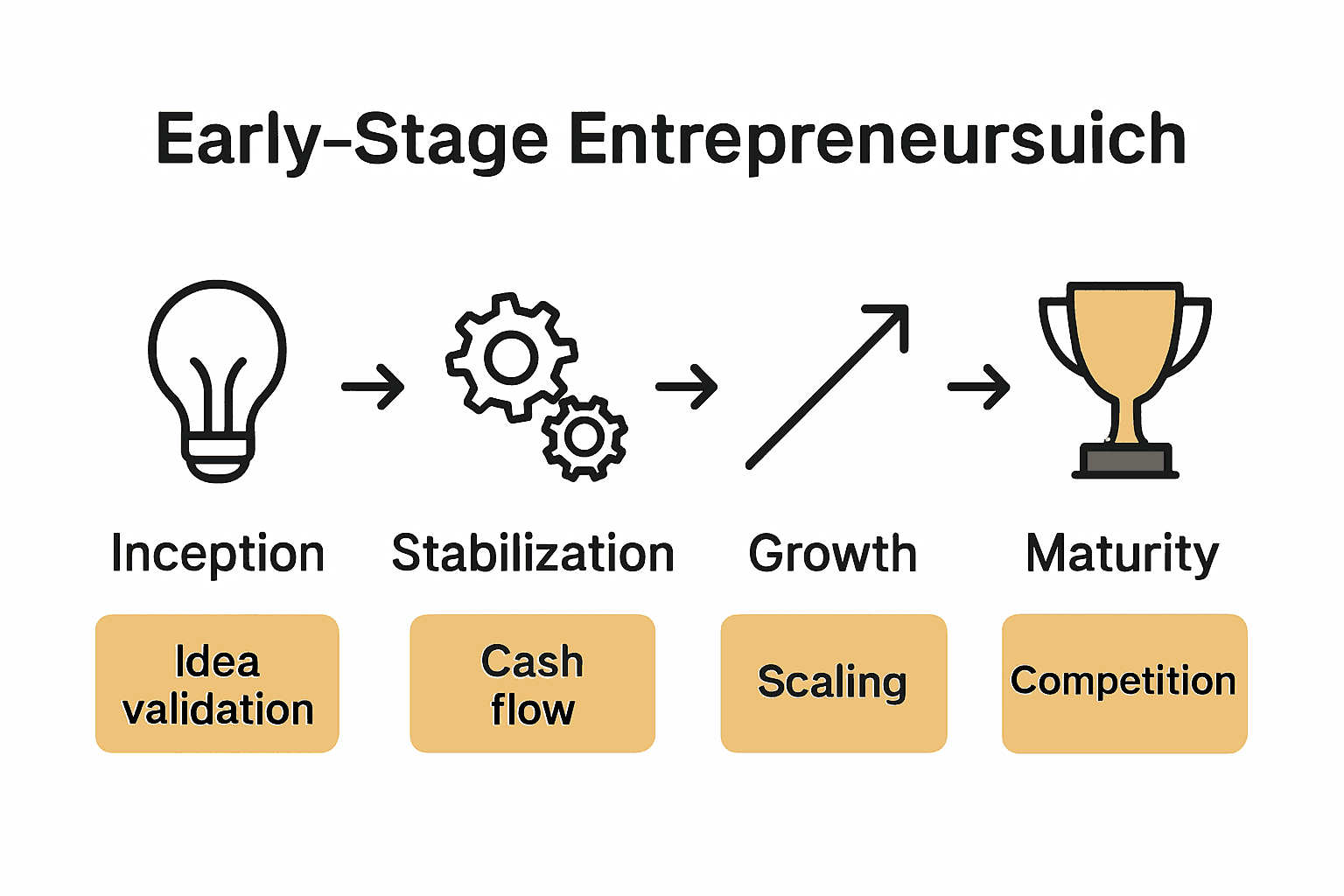
Startup development follows a structured progression through critical stages of evolution. According to arxiv, these stages typically include inception, stabilization, growth, and maturity, each representing a distinct phase of entrepreneurial development.
Here’s a comparison of key stages in startup development:
| Stage | Primary Focus | Common Challenges |
|---|---|---|
| Inception | Idea generation Feasibility | Market validation Resource limits |
| Stabilization | Product refinement Market entry | Competition Early customer traction |
| Growth | Scaling operations Customer expansion | Operational inefficiency Funding gaps |
| Maturity | Sustained profitability Market position | Competitive pressure Slower adaptation |
Key Developmental Stages include:
- Inception: Focused on idea generation and feasibility analysis
- Stabilization: Refining product and establishing market presence
- Growth: Scaling operations and expanding customer base
- Maturity: Achieving sustained profitability and market position
As research from arxiv highlights, early-stage startups encounter significant challenges like resource constraints and market uncertainties. Critical milestones entrepreneurs must navigate include developing a minimum viable product (MVP), achieving product-market fit, securing initial customers, and obtaining crucial investor funding.
The Founder Journey Map: Navigating the Startup Phase can provide additional insights into successfully traversing these complex developmental stages. Successful entrepreneurs understand that progression isn’t linear – it requires continuous adaptation, strategic pivoting, and resilient problem-solving across each stage of the startup journey.
Common Business Models and Approaches
Early-stage startups must strategically navigate diverse business models to establish market relevance and sustainable growth. According to arxiv, contemporary approaches increasingly emphasize rapid development and iterative learning methodologies, with the Lean Startup framework emerging as a particularly powerful strategy for minimizing risks and aligning product offerings with market demands.
Popular Startup Business Models include:
- Subscription-Based Services: Predictable recurring revenue
- Freemium Offerings: Basic services free, premium features paid
- Direct Sales: Straightforward transactional approach
- Platform-Based Models: Creating marketplace ecosystems
Research from arxiv reveals that choosing a business model depends on critical factors such as target market characteristics, unique value proposition, and the competitive landscape. Lean Startup methodology particularly stands out, focusing on building minimum viable products (MVPs) to test fundamental business hypotheses and gather actionable customer feedback.
Starting a New Venture? Steer Clear of These 5 Common Mistakes! provides additional insights into navigating these complex strategic decisions. Successful entrepreneurs understand that flexibility isn’t just beneficial – it’s essential. The ability to pivot, adapt, and continuously refine your approach based on real-world market responses can mean the difference between startup success and failure.

Essential Skills and Traits for Founders
Successful startup founders are distinguished by a unique blend of skills and personal attributes that go far beyond traditional business knowledge. According to arxiv, these entrepreneurs combine technical expertise, sophisticated business acumen, and exceptional leadership capabilities to navigate the complex startup landscape.
Critical Founder Skills include:
- Resilience: Maintaining composure under extreme uncertainty
- Decision-Making: Making informed choices with limited information
- Team Building: Attracting and inspiring talented professionals
- Communication: Effectively articulating vision and strategy
- Networking: Creating strategic partnerships and resources
Research from arxiv emphasizes the paramount importance of adaptability in entrepreneurial success. Founders must cultivate a mindset of continuous learning, demonstrating an extraordinary willingness to pivot strategies and remain attuned to emerging market trends.
What Are The Essential Components of a Business Plan provides additional context for translating these personal traits into actionable business strategies. The most successful founders understand that their greatest asset is not just their initial idea, but their capacity to evolve, learn, and transform challenges into opportunities.
Challenges, Risks, and Common Pitfalls
Startup journeys are fraught with complex challenges that test an entrepreneur’s resilience and strategic thinking. According to arxiv, early-stage startups frequently encounter significant obstacles including limited financial resources, intense market competition, and persistent operational inefficiencies.
Primary Startup Challenges include:
- Financial Constraints: Managing limited funding
- Market Misalignment: Potential product-market disconnect
- Scaling Difficulties: Inefficient operational growth
- Resource Underestimation: Miscalculating time and investment requirements
- Competitive Pressures: Navigating saturated market landscapes
Research from arxiv further highlights the complexity of entrepreneurial risks, emphasizing the critical importance of navigating regulatory environments and managing diverse stakeholder expectations. Successful founders must develop robust risk management strategies that enable them to adapt quickly and transform potential obstacles into strategic opportunities.
Starting a New Venture? Steer Clear of These 5 Common Mistakes! provides additional insights into mitigating these challenges. The most resilient entrepreneurs understand that challenges are not roadblocks, but essential learning experiences that refine their business approach and strengthen their strategic capabilities.
Accelerate Your Early-Stage Entrepreneurship Journey with Nomad Excel
Navigating early-stage entrepreneurship means overcoming challenges like limited resources, market uncertainties, and the constant need to adapt. This article highlights key pain points such as developing minimum viable products, securing initial funding, and building strategic resilience. If you want to move beyond theory into fast, focused execution while gaining support from experienced mentors and a thriving community, Nomad Excel is built to guide you.
Explore our Entrepreneurship Archives to dive deeper into startup strategies and mindset shifts. Ready to transform your startup challenges into opportunities for growth? Join one of our immersive entrepreneurship bootcamps or company retreats to sharpen your skills, validate your ideas, and fast-track your business success. Visit Nomad Excel now to take the next step toward clarity, execution, and community that propels your startup forward.
Frequently Asked Questions
What defines early-stage entrepreneurship?
Early-stage entrepreneurship involves the transition from a business concept to actively building a functional enterprise. This phase includes activities such as identifying market opportunities, developing business plans, and securing initial funding, typically within the first 42 months of operation.
What are the key stages of startup development?
The key stages of startup development include inception (idea generation and feasibility), stabilization (product refinement and market entry), growth (scaling operations and customer expansion), and maturity (achieving sustained profitability and market position).
What are some common business models for early-stage startups?
Common business models for early-stage startups include subscription-based services, freemium offerings, direct sales, and platform-based models. Choosing the right model often depends on factors such as target market characteristics and competitive landscape.
What skills are essential for successful startup founders?
Essential skills for startup founders include resilience, decision-making, team building, communication, and networking. Founders must also be adaptable and willing to learn continuously to navigate the challenges of the entrepreneurial landscape.
Comments are closed.