
Entrepreneurship Frameworks 2025: Strategies for Rapid Growth
Most American entrepreneurs face new challenges as technology transforms the way businesses are built. With artificial intelligence now at the core of many strategies, over 60 percent of startups report using advanced frameworks for faster growth and innovation. Keeping up with these changes is essential for anyone aiming to compete and succeed in 2025. This overview takes a closer look at the evolving tools, methods, and risks defining entrepreneurial success in the coming year.
Table of Contents
- Defining Entrepreneurship Frameworks in 2025
- Types of Frameworks: Lean, Agile, and Hybrid
- Key Features: Stages, Tools, and Metrics
- Evolving Trends Shaping Entrepreneurial Success
- Risks, Pitfalls, and How to Avoid Them
- Real-World Applications for Modern Entrepreneurs
Key Takeaways
| Point | Details |
|---|---|
| Embrace Technology | In 2025, successful entrepreneurs leverage AI and technology for innovative insights and operational efficiency. |
| Adopt Adaptive Frameworks | Utilizing Lean, Agile, and Hybrid frameworks allows entrepreneurs to respond quickly to changing market demands. |
| Focus on Continuous Learning | Entrepreneurs should prioritize skill development, technological proficiency, and personal growth to remain competitive. |
| Manage Risks Proactively | Developing comprehensive risk mitigation strategies helps address financial, technological, and market uncertainties effectively. |
Defining Entrepreneurship Frameworks in 2025
Entrepreneurship frameworks have become increasingly dynamic and technology-driven, representing strategic roadmaps that guide individuals and organizations through complex business development processes. In 2025, these frameworks are fundamentally reshaping how entrepreneurs conceptualize, launch, and scale their ventures, with artificial intelligence playing a transformative role. Emerging research from AI-enabled entrepreneurship studies demonstrates how technological integration is fundamentally redefining traditional entrepreneurial approaches.
The modern entrepreneurship framework encompasses more than linear business planning; it represents an adaptive, technology-integrated approach to creating and scaling ventures. Key components now include rapid experimentation, data-driven decision making, and leveraging technological capabilities to accelerate growth. Artificial intelligence has become a critical enabler, augmenting individual entrepreneurial capabilities through advanced skill development, risk assessment, and strategic planning mechanisms. Comprehensive business growth frameworks highlight how entrepreneurs can systematically approach innovation and market entry.
Critical elements of contemporary entrepreneurship frameworks in 2025 include:
- Technological Integration: Utilizing AI and machine learning for strategic insights
- Agile Methodologies: Embracing flexible, iterative approaches to business development
- Global Connectivity: Leveraging digital platforms for international market access
- Continuous Learning: Developing adaptive skills and embracing technological disruption
Entrepreneurs who successfully navigate these frameworks recognize that success requires more than traditional business knowledge. It demands a holistic understanding of technological ecosystems, strategic adaptability, and a willingness to continuously evolve. By embracing these principles, modern entrepreneurs can transform complex challenges into unprecedented opportunities for growth and innovation.
Types of Frameworks: Lean, Agile, and Hybrid
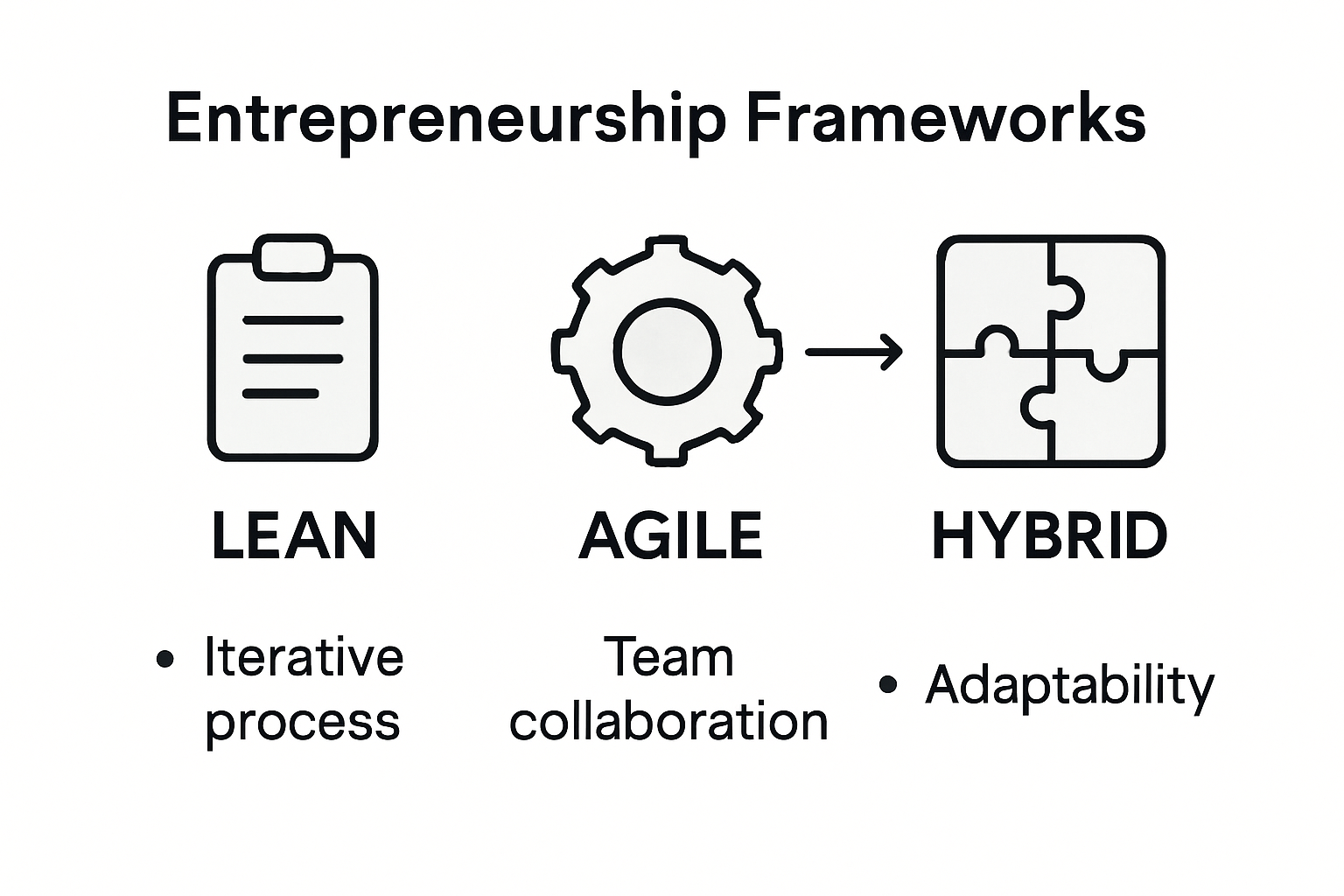
Entrepreneurs in 2025 have access to sophisticated business development frameworks that dramatically enhance their ability to innovate and scale. These frameworks – Lean, Agile, and Hybrid – represent strategic approaches that enable founders to navigate complex business landscapes with precision and adaptability. The Lean LaunchPad methodology exemplifies how modern frameworks combine multiple strategic perspectives to drive entrepreneurial success, integrating elements like customer development, business model design, and rapid experimentation.
The Lean Framework focuses on minimizing waste and maximizing customer value through continuous iteration and feedback. Entrepreneurs using this approach systematically test hypotheses, validate market assumptions, and pivot quickly based on real-world insights. In contrast, the Agile Framework emphasizes flexible, incremental development with short development cycles and constant adaptation. This approach allows entrepreneurs to respond rapidly to market changes, technological shifts, and emerging customer needs.
Key characteristics of these frameworks include:
Lean Framework:
- Rapid hypothesis testing
- Minimal resource investment
- Customer-centric approach
- Quick iteration cycles
Agile Framework:
- Flexible project management
- Incremental product development
- Regular team collaboration
- Continuous improvement
Hybrid Framework:
- Combines multiple methodological approaches
- Customizable to specific business contexts
- Leverages strengths of different frameworks
- Adaptable to technological disruptions
The Hybrid Framework represents the most sophisticated approach, allowing entrepreneurs to dynamically blend Lean, Agile, and other methodological strategies based on specific business requirements. By understanding and applying these frameworks strategically, modern entrepreneurs can create robust, adaptable business models that thrive in rapidly changing technological and economic environments.
Key Features: Stages, Tools, and Metrics
Entrepreneurial frameworks in 2025 are characterized by sophisticated, multi-stage approaches that transform innovative concepts into sustainable businesses. Emerging research on entrepreneurial frameworks reveals a structured progression involving three critical stages: imagination shaping, reality testing, and reality scaling. These stages provide entrepreneurs with a systematic method to develop and validate business ideas while minimizing risks and maximizing potential for success.

The Stages of Entrepreneurial Development represent a comprehensive journey from conceptualization to execution. In the imagination shaping stage, entrepreneurs generate and refine innovative ideas, leveraging advanced tools like AI-powered ideation platforms and market research technologies. The reality testing phase involves rigorous validation through prototype development, customer interviews, and iterative feedback mechanisms. Finally, the reality scaling stage focuses on strategic growth, resource allocation, and systematic expansion of successful business models.
Key tools and metrics for entrepreneurial frameworks include:
Essential Tools:
- AI-powered market analysis platforms
- Customer feedback and validation software
- Predictive financial modeling tools
- Collaborative project management systems
Critical Metrics:
- Customer acquisition cost
- Lifetime customer value
- Burn rate and financial sustainability
- Market penetration and growth velocity
- Innovation potential and adaptability index
The most effective entrepreneurs integrate these tools and metrics dynamically, creating a flexible ecosystem that adapts to changing market conditions. By understanding and applying these sophisticated frameworks, founders can transform creative concepts into robust, scalable business ventures that demonstrate remarkable resilience and potential for long-term success.
Evolving Trends Shaping Entrepreneurial Success
Entrepreneurship in 2025 is undergoing a profound transformation, driven by technological innovation, societal shifts, and emerging global challenges. University-led entrepreneurial resilience networks are playing a critical role in developing adaptive strategies that enable entrepreneurs to navigate increasingly complex business landscapes. These networks provide crucial support systems that help founders develop the mental fortitude, strategic thinking, and collaborative skills necessary for sustainable success.
The key trends reshaping entrepreneurial success are multifaceted, encompassing technological integration, social impact, and personal development. Technological advancements like artificial intelligence, blockchain, and advanced data analytics are fundamentally restructuring how entrepreneurs conceptualize, launch, and scale their ventures. Simultaneously, there is a growing emphasis on social entrepreneurship – businesses that prioritize solving global challenges while generating economic value. Emerging research on entrepreneurship development highlights the critical importance of inclusive frameworks that bridge technological and social gaps.
Critical emerging trends include:
Technological Transformation:
- AI-powered business intelligence
- Decentralized digital platforms
- Automated operational systems
- Predictive market analytics
Social and Inclusive Innovation:
- Purpose-driven business models
- Diversity and inclusion in entrepreneurship
- Sustainable and ethical business practices
- Global collaboration and knowledge sharing
Personal Development Trends:
- Continuous learning and skill adaptation
- Mental resilience and emotional intelligence
- Networked and collaborative entrepreneurship
- Holistic approach to business and personal growth
Successful entrepreneurs in 2025 will be those who can seamlessly integrate technological capabilities, social consciousness, and personal adaptability. By embracing these evolving trends, founders can create businesses that are not just economically viable, but also socially impactful and personally fulfilling.
Risks, Pitfalls, and How to Avoid Them
Entrepreneurial journeys are inherently complex, with numerous potential risks that can derail even the most promising ventures. Research on student entrepreneurship challenges reveals that understanding and proactively addressing potential pitfalls is crucial for sustainable success. Entrepreneurs must develop a strategic mindset that anticipates challenges and creates robust mitigation strategies before they become critical problems.
The most significant risks facing entrepreneurs in 2025 span multiple dimensions: financial vulnerability, technological disruption, market uncertainty, and personal burnout. Financial risks include inadequate capital management, poor cash flow projections, and over-reliance on single revenue streams. Technological risks emerge from rapid market changes, potential cybersecurity threats, and the challenge of maintaining technological relevance. Market risks involve unpredictable consumer behavior, intense competition, and global economic fluctuations. Systematic reviews of entrepreneurial methodologies emphasize the importance of structured risk assessment processes.
Key Risk Categories and Mitigation Strategies:
Financial Risks:
- Maintain multiple revenue streams
- Create comprehensive financial contingency plans
- Implement strict budget monitoring systems
- Develop diverse funding strategies
Technological Risks:
- Continuous skills upgrading
- Regular technology infrastructure assessments
- Cybersecurity investment
- Flexible technological adaptation strategies
Market Risks:
- Diversified market research
- Agile product development
- Customer feedback integration
- Rapid prototyping and iteration
Personal Risks:
- Mental health awareness
- Balanced work-life management
- Professional support networks
- Stress management techniques
Successful entrepreneurs understand that risk management is not about eliminating risks entirely, but developing adaptive strategies that transform potential challenges into opportunities for growth and innovation. By maintaining a proactive, flexible approach and continuously learning from both successes and setbacks, founders can build resilient businesses that thrive in an increasingly complex global landscape.
Real-World Applications for Modern Entrepreneurs
Entrepreneurship in 2025 demands a sophisticated approach that integrates cutting-edge technology with human creativity and strategic thinking. AI-empowered entrepreneurship education systems are revolutionizing how founders develop skills, validate ideas, and navigate complex business landscapes. These advanced frameworks combine technological innovation with experiential learning, enabling entrepreneurs to rapidly prototype, test, and scale their ventures with unprecedented precision.
The practical application of modern entrepreneurial frameworks involves multiple interconnected strategies. Technology serves as a powerful enabler, providing entrepreneurs with advanced tools for market analysis, customer insights, and operational optimization. Artificial intelligence plays a crucial role in transforming traditional business processes, offering predictive analytics, automated decision-making support, and personalized learning experiences that adapt to individual entrepreneurial needs. Comprehensive entrepreneurship competence frameworks emphasize the importance of developing both technological proficiency and human-centric skills.
Key Real-World Application Strategies:
Technological Integration:
- AI-powered market research
- Predictive business modeling
- Automated customer interaction systems
- Real-time performance analytics
Skills Development:
- Continuous learning platforms
- Adaptive skill assessment tools
- Personalized entrepreneurial coaching
- Cross-disciplinary knowledge integration
Operational Optimization:
- Streamlined workflow automation
- Dynamic resource allocation
- Agile project management
- Scalable business infrastructure design
Successful modern entrepreneurs understand that real-world application is not about adopting technology blindly, but strategically leveraging innovative tools to solve complex business challenges. By maintaining a balance between technological capabilities and human creativity, founders can build resilient, adaptive businesses that thrive in an increasingly dynamic global ecosystem.
Accelerate Your Growth with Proven Entrepreneurship Frameworks
The article highlights the challenges entrepreneurs face in 2025, from mastering technology integration to managing risk and maintaining agility in a rapidly changing landscape. If you are struggling to apply Lean, Agile, or Hybrid frameworks effectively or want to develop the critical skills needed for rapid business scaling, you are not alone. The need for clear strategies, hands-on mentorship, and a supportive community has never been greater for turning ideas into sustainable success.
At Nomad Excel, we partner with driven founders like you to bridge this gap. Our Entrepreneurship Archives offer deep insights into strategic frameworks while our immersive bootcamps provide step-by-step guidance for validating and accelerating your business. Whether you are launching a new venture or scaling an existing one, our programs combine expert mentorship, structured execution, and a tight-knit community to give you the clarity and momentum needed to thrive. Don’t wait for the future of entrepreneurship to pass you by. Explore more of our resources at Nomad Excel and get ready to transform challenges into opportunities.
Ready to elevate your entrepreneurial journey? Start your adventure by visiting our Inspiration Archives and join a community that drives real-world growth today.
Frequently Asked Questions
What are the key components of entrepreneurship frameworks in 2025?
The key components include technological integration, agile methodologies, global connectivity, and continuous learning, all of which help entrepreneurs adapt and thrive in a rapidly changing environment.
How do Lean and Agile frameworks differ in entrepreneurship?
The Lean framework focuses on minimizing waste and maximizing customer value through continuous iteration, while the Agile framework emphasizes flexible, incremental development with short project cycles to adapt quickly to change.
What tools are essential for implementing modern entrepreneurial frameworks?
Essential tools include AI-powered market analysis platforms, customer feedback software, predictive financial modeling tools, and collaborative project management systems that enable effective decision-making and innovation.
What are the primary risks entrepreneurs face in 2025, and how can they mitigate them?
Primary risks include financial vulnerability, technological disruption, market uncertainty, and personal burnout. Entrepreneurs can mitigate these by maintaining multiple revenue streams, upgrading skills continuously, conducting diverse market research, and managing work-life balance effectively.
Recommended
- Complete Guide to Business Growth Frameworks
- Business Growth Strategy Workflow for Fast Results
- The Essential Guide to Frameworks for Business Building
- Business Growth in 2025: The Essential Guide – Nomad Excel – Your Entrepreneurial Adventure Starts Here
- Growth Marketing Strategy Guide for Ambitious Brands 2025 – ApusNest Blog | ApusNest
- Understanding Digital Growth Strategies for SMBs – Go Online Now
- Business Growth Strategies Explained: Complete Overview – Click Thrive Marketing
Comments are closed.