
What Is Business Scaling and Why It Matters
More than half of American entrepreneurs struggle to scale their businesses efficiently according to recent studies. Rapid growth can bring unexpected headaches if a company’s systems and processes are not prepared. Understanding what true business scaling means and learning its essential principles help American owners sidestep common mistakes and unlock lasting, manageable success in highly competitive markets.
Table of Contents
- Defining Business Scaling And Core Principles
- Types Of Scaling: Organic Vs. Strategic Growth
- Key Characteristics Of Scalable Businesses
- Requirements And Systems For Effective Scaling
- Common Pitfalls And How To Avoid Them
Key Takeaways
| Point | Details |
|---|---|
| Business Scaling | Business scaling involves systematic growth without proportional increases in operational costs, focusing on sustainability and efficiency. |
| Growth Strategies | Companies can choose between organic growth, which leverages internal resources, and strategic growth, which requires external resources for rapid expansion. |
| Characteristics of Scalable Businesses | Successful scalable businesses feature standardized processes, adaptable teams, and robust technological systems that facilitate growth. |
| Avoiding Common Pitfalls | Entrepreneurs must be cautious of overexpansion and ensure they maintain core competencies and solid financial planning to support sustainable growth. |
Defining Business Scaling and Core Principles
Business scaling represents a strategic approach to systematic organizational growth where companies expand their capabilities, revenue, and market presence without proportionally increasing operational costs. At its core, scaling is about creating sustainable expansion models that amplify business potential while maintaining efficiency and performance.
The fundamental principles of business scaling revolve around developing robust frameworks for sustainable expansion that enable organizations to handle increased demand effectively. According to Forbes, scalability fundamentally requires standardizing processes, investing in technology, building cohesive teams, and implementing strong accounting controls to support ongoing development. This means creating systems that can handle growth without breaking down or requiring exponential increases in resources.
Successful scaling involves several key strategic components. Businesses must focus on:
- Developing repeatable and standardized processes
- Implementing scalable technological infrastructure
- Building adaptable and skilled teams
- Creating financial models that support sustainable growth
- Maintaining operational flexibility
Pro tip for Aspiring Entrepreneurs: Start mapping your business scaling strategy early by identifying potential bottlenecks and creating systematic solutions before growth pressures emerge, allowing you to scale smoothly and strategically.
Types of Scaling: Organic vs. Strategic Growth
Business growth strategies fundamentally divide into two primary approaches: organic growth and strategic growth. Each method offers unique pathways for expanding a company’s market presence, capabilities, and overall performance.
Organic growth strategies focus on internal development, leveraging existing resources to incrementally expand business operations. This approach involves strengthening core competencies, improving product lines, enhancing marketing efforts, and developing new capabilities using the company’s current infrastructure. Entrepreneurs typically pursue organic growth by increasing productivity, refining operational processes, and gradually expanding their customer base through proven internal mechanisms.
In contrast, strategic growth involves more aggressive expansion tactics that extend beyond internal capabilities. This approach often includes:
- Mergers and acquisitions
- Strategic partnerships
- Market diversification
- Technology integration
- Entering new geographic markets
The key distinction between these growth models lies in their implementation speed and resource allocation. Organic growth tends to be slower but more controlled, while strategic growth can rapidly accelerate business expansion through external opportunities and collaborative ventures.
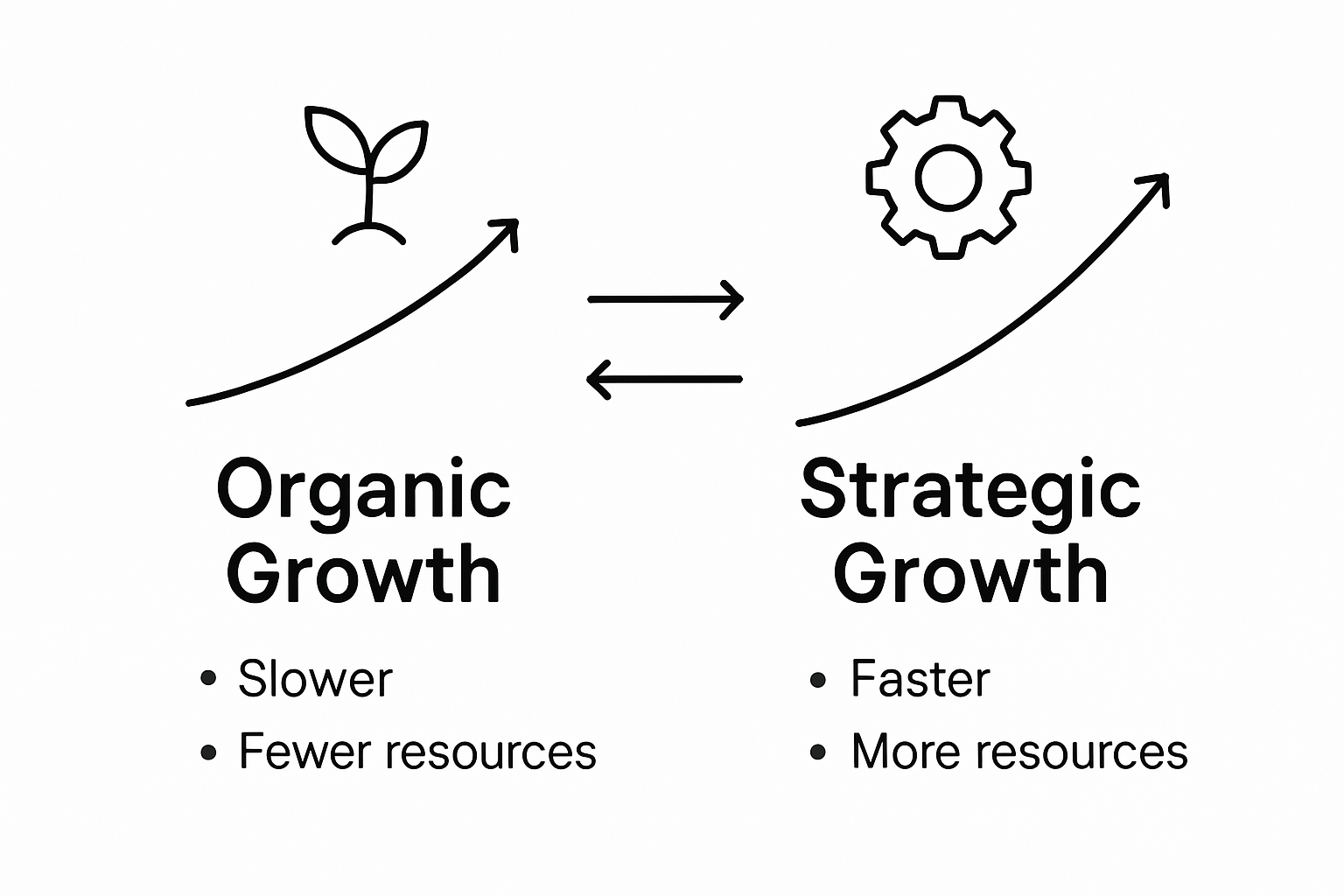
Here’s a comparison of organic and strategic business growth approaches:
| Approach | Typical Speed | Resource Requirements | Best For |
|---|---|---|---|
| Organic Growth | Gradual, controlled | Uses existing resources | Building core strengths steadily |
| Strategic Growth | Fast, accelerated | Requires external resources | Rapid market expansion and diversification |
Pro tip for Business Scaling: Carefully analyze your company’s current strengths and market positioning before selecting a growth strategy, ensuring your chosen approach aligns with your long-term business objectives and available resources.
Key Characteristics of Scalable Businesses
Scalable businesses are distinguished by their ability to grow efficiently without compromising performance or experiencing exponential increases in operational complexity. These organizations develop systems and structures that enable sustainable expansion while maintaining core operational integrity and strategic focus.

Standardized business processes form the backbone of scalable enterprises. This involves creating repeatable workflows, implementing consistent operational protocols, and developing systems that can be easily replicated and adapted as the business grows. Successful scalable businesses invest in technological infrastructure that supports seamless communication, automates routine tasks, and provides real-time insights into business performance.
The key characteristics of scalable businesses include:
- Robust and flexible technological systems
- Clear and documented operational processes
- Adaptable organizational structures
- Strong leadership and decision-making frameworks
- Efficient resource allocation mechanisms
- Continuous learning and improvement culture
- Data-driven strategic planning
Financial management plays a critical role in scalability. This involves maintaining lean operational costs, creating efficient cash flow management systems, and developing financial models that can accommodate rapid growth without creating unsustainable overhead. Scalable businesses also prioritize building talented, adaptable teams that can evolve alongside the organization’s changing needs.
Pro tip for Business Scalability: Regularly audit your business processes and technological infrastructure, identifying potential bottlenecks and inefficiencies before they become significant obstacles to growth.
Requirements and Systems for Effective Scaling
Scaling a business requires a comprehensive approach that integrates strategic planning, technological infrastructure, and organizational capabilities. Successful scaling is not simply about growing larger, but about creating a sophisticated ecosystem that can adapt and respond to increasingly complex business challenges.
Strategic business scaling frameworks demand a holistic approach that encompasses multiple critical components. This involves developing clear organizational vision, aligning team capabilities with strategic objectives, and implementing robust systems that can support exponential growth without compromising operational efficiency or quality of service.
The fundamental requirements for effective scaling include:
- Clear and compelling organizational mission
- Scalable technological infrastructure
- Adaptive organizational structures
- Performance measurement and monitoring systems
- Talent development and recruitment strategies
- Flexible financial management processes
- Continuous learning and innovation mechanisms
Technological systems play a pivotal role in business scaling. Entrepreneurs must invest in integrated platforms that enable seamless communication, automate critical workflows, provide real-time data analytics, and support decision-making processes. These systems should be designed with future growth in mind, allowing for easy modification and expansion as the business evolves.
This table summarizes essential systems needed for scalable business growth:
| System Type | Core Purpose | Example Benefit |
|---|---|---|
| Technological Infrastructure | Supports automation and analytics | Faster decision-making |
| Performance Monitoring | Tracks progress and identifies issues | Early detection of bottlenecks |
| Talent Development | Ensures skill growth with business needs | Smarter team adaptation |
| Financial Management | Manages scaling costs and investments | Sustainable cash flow during growth |
Pro tip for Business Growth: Build technological and organizational systems with intentional flexibility, anticipating potential expansion points and designing infrastructure that can scale without requiring complete redesign.
Common Pitfalls and How to Avoid Them
Business scaling is a complex journey fraught with potential challenges that can derail even the most promising entrepreneurial ventures. Understanding and anticipating these obstacles is crucial for maintaining sustainable growth and preventing catastrophic setbacks.
Common scaling challenges emerge from several critical areas of business development. Entrepreneurs often struggle with overexpansion, which occurs when businesses grow faster than their operational capabilities can support. This typically manifests through rapid hiring, premature market expansion, or investing in infrastructure before establishing a solid revenue foundation.
Key pitfalls entrepreneurs must navigate include:
- Premature scaling beyond financial capacity
- Neglecting core business competencies
- Inadequate financial planning and cash flow management
- Failing to develop scalable operational systems
- Inconsistent team communication and alignment
- Underestimating technological infrastructure requirements
- Losing focus on primary business objectives
Maintaining strategic discipline requires continuous assessment of business capabilities and market conditions. Successful entrepreneurs develop robust monitoring mechanisms that provide early warning signals about potential scaling challenges. This involves creating flexible systems that can adapt quickly, maintaining lean operational structures, and consistently realigning resources with core business objectives.
Pro tip for Scaling Strategy: Implement quarterly strategic reviews that critically evaluate your business’s growth trajectory, comparing actual performance against original scaling projections and making data-driven adjustments to your expansion strategy.
Accelerate Your Business Scaling Journey with Nomad Excel
If you are tackling the challenge of scaling your business without losing control over operations or stretching your resources too thin, you are not alone. This article highlights common obstacles like premature scaling, inefficient systems, and lack of strategic alignment that often stop entrepreneurs from realizing sustainable growth. At Nomad Excel, we specialize in helping driven founders and teams overcome these hurdles by focusing on clarity, execution, and community to build scalable business models.
Explore our Entrepreneurship Archives to gain insights that complement your scaling strategies, and dive into our Program Archives to find immersive bootcamps designed to equip you with practical frameworks, mentorship, and accountability you need right now. Don’t let bottlenecks slow your growth. Visit Nomad Excel today to discover how our hands-on experiences and expert guidance can help you confidently expand without compromising your core business strengths.
Frequently Asked Questions
What is business scaling?
Business scaling is a strategic approach to systematic organizational growth, allowing companies to expand their capabilities, revenue, and market presence without proportionally increasing operational costs.
Why is business scaling important?
Business scaling is important because it enables organizations to handle increased demand efficiently, create sustainable expansion models, and maintain operational performance without incurring excessive costs.
What are the main types of business growth strategies?
The main types of business growth strategies are organic growth, which focuses on internal development and resource optimization, and strategic growth, which involves external tactics like mergers, acquisitions, and market diversification.
What are common pitfalls to avoid when scaling a business?
Common pitfalls include premature scaling beyond financial capacity, neglecting core competencies, inadequate financial planning, and failing to establish scalable operational systems.
Comments are closed.