
Step by Step Business Launch: Guide to Starting Strong
Launching an American business means stepping into a world where only about 50 percent of new ventures survive beyond five years. This first stage is critical because clear direction and focus can separate lasting success from costly missteps. By understanding how to define both your business idea and your audience, you set yourself up to overcome common pitfalls and build a strong foundation right from the start.
Table of Contents
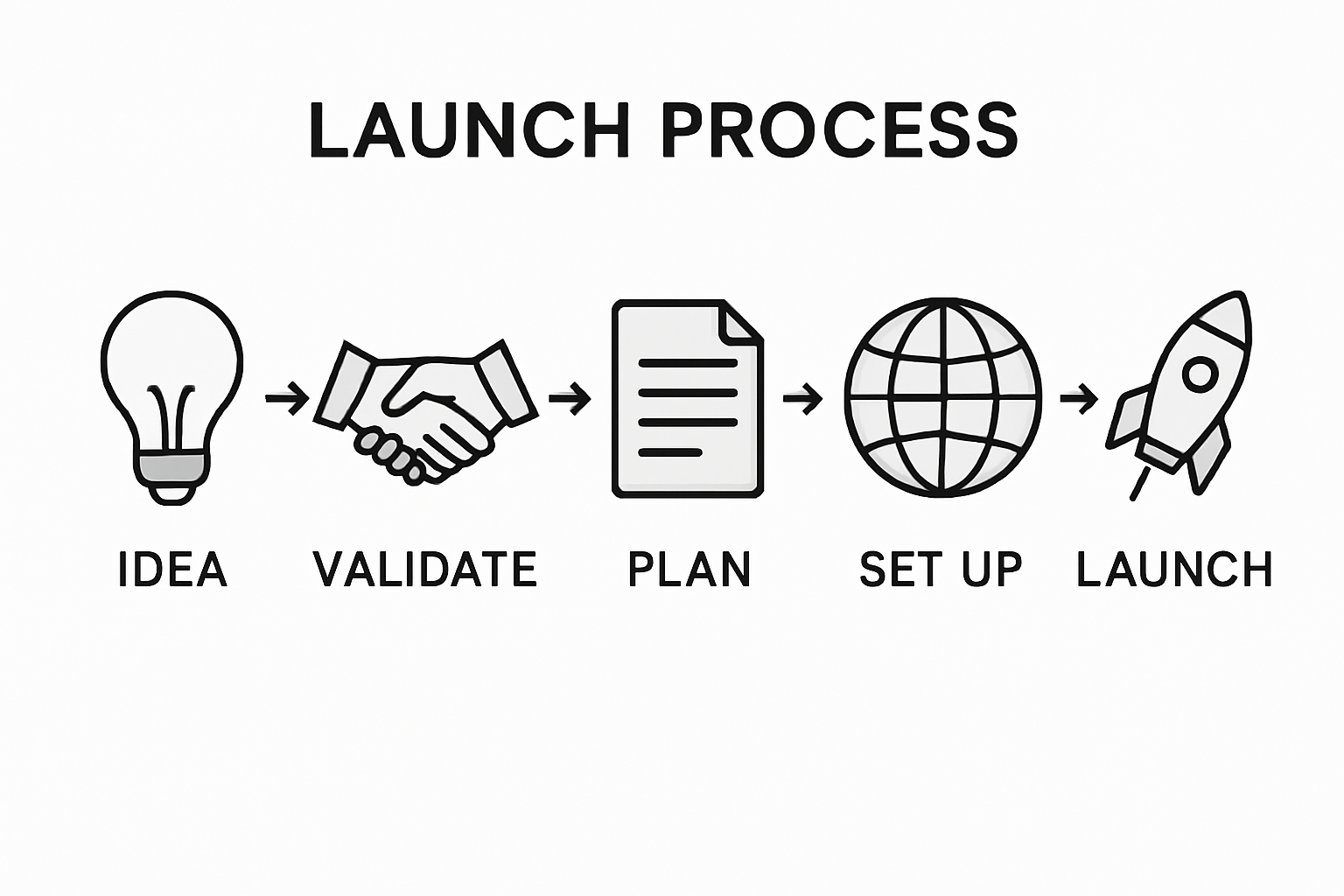
- Step 1: Define Your Business Idea And Audience
- Step 2: Validate Demand And Refine Your Offer
- Step 3: Develop Your Business Model And Plan
- Step 4: Register, Set Up Operations, And Build Online Presence
- Step 5: Launch, Monitor Results, And Iterate
Quick Summary
| Key Point | Explanation |
|---|---|
| 1. Define Your Business Idea Clearly | Articulate a business concept that addresses a specific market problem and connects with your target audience effectively. |
| 2. Validate Demand with Real Feedback | Engage potential customers to confirm interest in your solution and refine your offering based on their insights. |
| 3. Develop a Comprehensive Business Plan | Create a detailed document outlining goals, strategies, and financial projections to guide your business operations. |
| 4. Establish a Strong Online Presence | Create a professional website and digital profiles to enhance credibility and attract your target audience. |
| 5. Monitor Performance and Adapt | Implement tracking systems to gather performance metrics, allowing for responsive adjustments to your business strategy. |
Step 1: Define Your Business Idea and Audience
Defining a robust business idea is the foundational moment where your entrepreneurial vision transforms from abstract concept to potential reality. In this crucial first step, you will articulate a commercially viable business concept that solves a specific market problem and connects powerfully with your intended consumers.
Successful business ideas emerge from understanding two key elements: your unique value proposition and the precise segment of people who will benefit most from your solution. Start by identifying a problem you are passionate about solving. Ask yourself critical questions: What challenges do potential customers face? What innovative approach can you bring to address those challenges? Your business idea should not just be interesting but economically sustainable.
Research becomes your strategic ally in this process. Conduct thorough market analysis to understand your target audience’s specific needs and preferences. This means diving deep into demographic data, surveying potential customers, and analyzing existing solutions in your chosen market. The more precisely you can define who will benefit from your product or service, the more effectively you can design and market your business offering.
Warning: Avoid the common entrepreneurial trap of falling in love with your idea without validating its market potential. Talk to potential customers, gather honest feedback, and be willing to pivot your concept based on real-world insights. Your first idea is rarely your best idea.
As you complete this foundational step, you will have a clear understanding of your business concept and the specific audience it serves. This clarity sets the stage for developing a compelling business strategy and preparing for the next phase of your entrepreneurial journey.
Step 2: Validate Demand and Refine Your Offer
Validating market demand is a critical transition from conceptual business idea to potential real-world success. In this crucial stage, you will systematically test whether customers actually want your proposed solution and understand how to refine your offering to meet genuine market needs.
Start by engaging with entrepreneurs and potential customers to enhance your opportunity recognition skills. This means conducting targeted market research through multiple channels such as surveys, interviews, focus groups, and prototype testing. Create a minimum viable product (MVP) that demonstrates your core value proposition and seek direct feedback from your potential target audience. Pay close attention to their responses not just to what they say, but how they say it. Look for emotional reactions, specific language they use, and underlying pain points that might reveal deeper market insights.
Your validation process should include both quantitative and qualitative assessment strategies. Quantitative methods might involve online surveys with specific demographic targeting, analyzing conversion rates on landing pages, or running small-scale advertising experiments to gauge interest. Qualitative approaches include one-on-one customer interviews, observing potential users interact with your prototype, and gathering detailed narratives about their experiences and challenges.
Warning: Avoid confirmation bias during this validation stage. Many entrepreneurs unconsciously seek feedback that merely confirms their existing beliefs. Instead, remain genuinely open to critique and be prepared to pivot or substantially modify your original concept based on authentic market signals.
As you complete this validation phase, you will have transformed your initial business idea from a hypothesis into a data-driven, market-tested concept with clear potential for success. The insights gained here will be instrumental in shaping your business strategy and preparing for the next steps of your entrepreneurial journey.
Step 3: Develop Your Business Model and Plan
Developing a robust business model and comprehensive plan transforms your validated business concept into a strategic roadmap for success. In this critical stage, you will craft a detailed blueprint that describes how your organization will create, deliver, and capture value.

Your business model should articulate the core components of your entrepreneurial vision. Begin by clearly defining your value proposition what unique problem you solve and for whom. Map out your target customer segments, revenue streams, key resources, and primary cost structures. This means diving deep into understanding the economic mechanics of your business. How will you generate income? What are your primary expenses? What makes your approach distinctive in the marketplace?
Next, develop a formal document that outlines your business goals, strategies, and financial projections. Your business plan serves two critical functions: it acts as an internal strategic guide and a potential tool for securing external funding. Break down your plan into key sections including executive summary, company description, market analysis, organization structure, product or service details, marketing and sales strategies, and financial projections. Be precise and realistic in your estimations, using market research and validated data to support your predictions.
Warning: Avoid creating a business plan that exists only as a theoretical document. Your plan must be a living, adaptable strategy that you regularly review and adjust based on real world performance and market changes. Treat it as a dynamic tool for guidance rather than a static bureaucratic requirement.
As you complete this phase, you will have transformed your initial business idea into a structured, actionable strategy with clear pathways for growth and development. The business model and plan you create now will serve as your entrepreneurial compass, guiding critical decisions and helping you navigate the complex landscape of building a successful venture.
Step 4: Register, Set Up Operations, and Build Online Presence
This critical phase transforms your business concept into a legally recognized and professionally positioned enterprise. You will navigate the essential steps of establishing your business infrastructure and creating a compelling digital footprint that attracts potential customers and establishes your credibility.
Establishing a comprehensive marketing framework is fundamental to guiding your business operations and attracting potential investors. Begin by selecting the appropriate legal business structure such as sole proprietorship, partnership, limited liability company (LLC), or corporation. Research local and state requirements for business registration, tax identification numbers, and necessary permits or licenses specific to your industry. This legal groundwork protects your personal assets and creates a formal foundation for your entrepreneurial venture.
Next, develop buyer personas and evaluate the feasibility of your business idea through strategic market positioning. Set up essential operational infrastructure including business banking accounts, accounting systems, and basic financial tracking mechanisms. For your online presence, create a professional website that clearly communicates your value proposition, develop consistent branding across digital platforms, and establish professional social media profiles that align with your target audience.
Warning: Do not underestimate the importance of professional digital representation. Your online presence is often the first interaction potential customers have with your business. Invest time in creating a polished, consistent, and authentic digital brand that reflects your unique value and professionalism.
As you complete this phase, you will have transformed your business from a concept into a legally recognized, operationally sound enterprise with a compelling digital identity. The groundwork you establish now creates the platform from which your entrepreneurial journey will launch and grow.
Step 5: Launch, Monitor Results, and Iterate
This pivotal stage transforms your meticulously planned business from concept to active operation. You will navigate the critical process of introducing your product or service to the market and establishing a dynamic system of continuous improvement and strategic adaptation.
Transform your business idea through systematic stages of imagination, reality testing, and strategic scaling. Begin by executing a soft launch that allows you to gather initial customer feedback and performance metrics. Implement robust tracking systems to monitor key performance indicators such as customer acquisition costs, conversion rates, revenue streams, and customer satisfaction. These metrics will provide actionable insights into your business’s real-world performance and highlight areas requiring immediate attention or strategic refinement.
Develop validated assessment scales to measure your entrepreneurial decision-making propensity and guide strategic iterations. Create a flexible feedback loop that enables rapid response to market signals. This means establishing clear processes for collecting customer insights, analyzing performance data, and making informed adjustments to your product, marketing approach, or operational strategy. Be prepared to pivot quickly while maintaining your core value proposition.
Warning: Avoid the trap of perfectionism. Your first launch will not be flawless, and that is perfectly normal. What matters is your ability to learn quickly, adapt intelligently, and maintain forward momentum.
As you complete this phase, you will have transformed your business from a static plan into a living, breathing enterprise capable of responding dynamically to market demands. The launch is not an endpoint but the beginning of an exciting journey of continuous growth and refinement.
Launch Your Business with Confidence Through Guided Support
Starting a business can feel overwhelming when faced with defining your idea, validating the market, and building a solid plan. This guide highlights common challenges like avoiding confirmation bias during validation and creating a living business plan that adapts over time. If you want to move beyond theory and take decisive, structured action, the right support system makes all the difference. Nomad Excel’s immersive programs provide step-by-step frameworks, expert mentorship, and a community of driven entrepreneurs ready to help you navigate each stage of your launch.
Explore real-world insights and actionable strategies with our Entrepreneurship Archives or discover how our hands-on bootcamps accelerate growth in the Program Archives. Don’t wait for perfection or risk costly mistakes alone. Visit Nomad Excel today and take the next confident step toward launching a successful business with clarity, execution, and lasting support.
Frequently Asked Questions
How do I define my business idea and target audience?
To define your business idea, start by identifying a specific problem you are passionate about solving and consider who will benefit from your solution. Create a profile of your ideal customers and conduct market research to understand their needs and preferences.
What steps should I take to validate demand for my business idea?
To validate demand, engage with potential customers through surveys, interviews, or prototype testing. Gather feedback to understand if your proposed solution meets their needs and be willing to adapt your idea based on their responses.
What should be included in my business model and plan?
Your business model and plan should outline your value proposition, target customer segments, revenue streams, and cost structures. Break down your plan into sections such as market analysis, marketing strategies, and financial projections for a clear roadmap.
What legal steps are necessary to register my business?
To register your business, choose the appropriate legal structure such as a sole proprietorship or LLC, and complete the required registration with your local authorities. Research any necessary permits or licenses needed in your industry to ensure compliance.
How can I effectively launch my business and monitor results?
To launch your business, consider starting with a soft launch to gather initial customer feedback and track key performance indicators. Set up a system for collecting and analyzing data to make informed adjustments based on performance insights and customer needs.
What should I do if my first launch doesn’t go as planned?
If your first launch doesn’t go as planned, focus on learning from the experience and adapting your approach. Gather feedback, identify areas for improvement, and be ready to pivot your strategy while keeping your core value proposition intact.
Comments are closed.